NJ Bridgewater

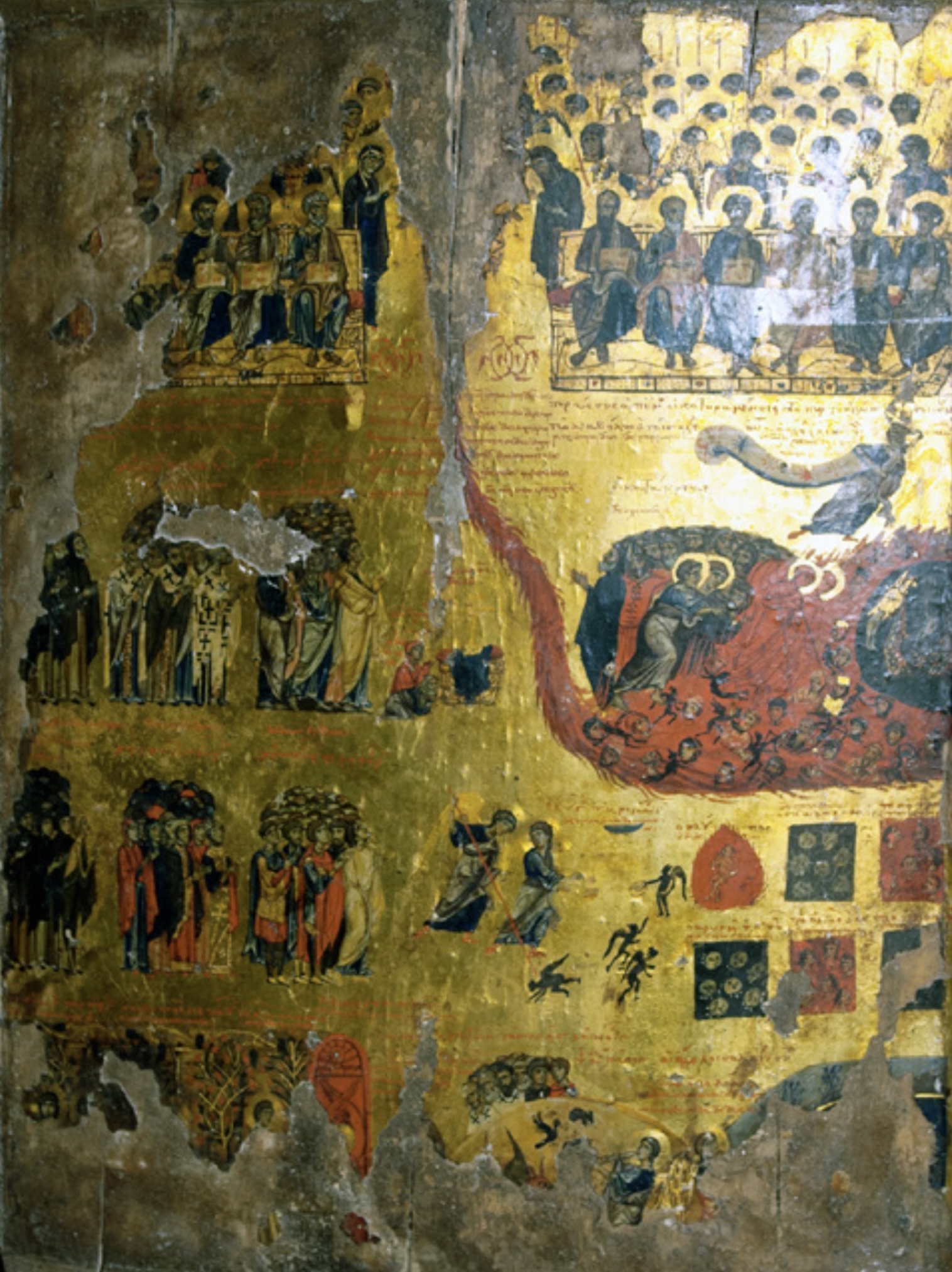
The Last Judgement, icon by John Tohabi
‘…And ye shall see the Son of man sitting on the right hand of power, and coming in the clouds of heaven.’[2]
- Mark 14:62
Introduction
There are several topics which frequently come up in relation to the finality of religion, the end times, and the concepts of salvation, resurrection, judgment and return. One of these is the issue of the return of Christ. Jesus of Nazareth was a historical person who lived in the 1st century AD. Outside of the Gospels, there is little information about Jesus, other than a few contemporary accounts, e.g. from Josephus (c. 37 – 100 AD),[3] and subsequent accounts of the early Christian community,[4] or the ‘Church’,[5] as it came to be called. We know that Jesus of Nazareth existed, that He was a wandering teacher, His mother’s name was Mary, and He had a step-father named Joseph, who was a descendant of the House of David. He was baptized by John the Baptist, began teaching a core set of beliefs, had twelve main disciples, one of whom betrayed Him, and a number of other followers, including a group of women, including Mary Magdalene. After two or three years of teaching, He was accused of blasphemy, tried before the Sanhedrin, and then executed by Pontius Pilate, the Roman governor, for the crime of claiming to be the ‘King of the Jews’, i.e. the Messiah. He was scourged and then crucified, and His body was taken down from the cross and placed in a grave protected by a large stone. After three days, His disciples said that the tomb was empty, and they came to a realisation known as the ‘Resurrection’ of Jesus Christ, and began teaching this widely.[6]
Before Jesus was killed, He promised to His disciples that He would return,[7] and fulfil the Biblical prophecies related to the Lord of Hosts.[8] He gave a number of signs which would indicate when He was going to return, including reference to date prophecies which gave the exact year of His return (i.e. those from Daniel).[9] He also warned about false prophets and Messiahs who would come in the meantime,[10] and many did appear throughout the centuries, leading people astray. While on Earth, Jesus’s disciples said that He performed a number of miracles, but Jesus did not generally permit these to be reported and did not consider them proofs. Rather, the only miracle which He regarded as proof of His Mission was that the Temple would be destroyed and raised again in three days,[11] which is a reference to the Resurrection. His core teachings were contained in the Sermon on the Mount,[12] and He taught mainly in parables,[13] emphasising spiritual qualities and meanings and discouraging literal interpretations and physical concepts,[14] e.g. physical resurrection. He taught, as Paul relates, that flesh and blood cannot inherit the Kingdom of Heaven,[15] meaning that resurrection was a spiritual, and not a literal concept.[16]
The Problem – Scriptural Literalism

Almost two thousand years have now passed since the crucifixion of Christ in 33 AD.[18] We know that it happened in 33 AD because of the exact prophecies in the Book of Daniel. We also know that Christ was born between 2 – 3 BC, i.e. around the year 309 Anno Graecorum (Seleucid Era).[19] There was no year 0, so the latest He could have been born was the traditional date of 1 AD. It may have coincided with the conjunction of Jupiter and Venus near Regular, i.e. possibly the Star of Bethlehem, which took place on 17 June 2 BC, or an earlier Venus-Jupiter conjunction in August, 3 BC,[20] or 11 September 3 BC.[21] Another candidate for the Star of Bethlehem was a supernova of 23 February 4 BC.[22] Over the centuries, Christians have looked towards the Second Coming of Christ, which is referred to in Greek as the Parousia (lit. ‘coming, presence, being near’).[23] Early Christians believed it would happen in their own lifetimes, and even some modern Christians interpret this as happening in 70 AD, when the Jewish Temple was destroyed in line with Christ’s prophecy. Some believed that He would return in the year 1000 AD, others in 1666 AD,[24] and then, in line with the prophecies of Daniel, the years 1844 AD and 1863 AD, both of these latter dates being definitive—Christ cannot have returned any time later than 1844 AD or 1863 AD.[25] As time has passed, and the dates prophesied by Daniel have also passed, many Christians now ignore the significance of the Second Coming, and focus more on belief in Christ and salvation. This is especially true of Protestants, including evangelicals, who focus on salvation through faith by grace, while many Catholics and others focus on either social improvement or traditionalism. There is little doubt that Christianity is locked in traditions that have accumulated over the centuries, dogmas that were established in the first few centuries and modified over the ages, and institutions and practices which are not entirely different from those critiqued by Jesus in the 1st century. There is little difference between institutions and practices of traditional Christianity and those of the Pharisees and Sadducees of the New Testament—both focused on practice, literalism, and disregard for new interpretations of Biblical prophecy. Focus on salvation through faith likewise disregards the importance of the central teachings of Christ, which were about behaviour, morality, spirituality and attitude, and were equally as important as faith. But all branches of Christianity suffer from a focus on literalism, which is the main veil between a seeker and the truth.
We must remember that the reason the Pharisees and Sadducees mostly rejected Christ is not because they ignored His obvious fulfilment of Biblical prophecy and miracles, which would seem to be a grand error on their part if true, but because of Biblical literalism, maintenance of power and respect for authority and tradition, and the veil of Jesus’s mortality, poverty and humanity. The miracles of Jesus were not proofs in themselves, as they had to be witnessed in person to be believed, nor did the Pharisees and Sadducees witness His resurrection. Therefore, they saw only a human being, not a divine miracle-worker. When Jews say that they do not believe Jesus is the Messiah, it is because He did not literally fulfil the prophecies of the Old Testament Prophets. The Gospels do reference prophecies that Jesus did fulfil, but these are often difficult to verify (e.g. Jesus’s stay in Egypt) and require a new interpretation of verses that have traditionally been interpreted otherwise.
The point is this: If the Pharisees and Sadducees were swapped with modern-day priests and pastors, who were not aware of the New Testament and only had knowledge of the Old Testament, the same result would have occurred. They would have rejected Jesus Christ and called for His crucifixion. Likewise, if Jesus Christ appeared again, but WITHOUT literal Biblical fulfilment, i.e. He appeared in a way that they did not expect, then the Christian churches would also reject Him now. If that is the case, then their belief in Christ really should depend on their ability to recognise Him if He came again, whereas now most believe only because of hindsight and acceptance of the miracles and resurrection stories as being literal events, and the overwhelming success of Christianity throughout the ages. The point is, therefore, that most of those who currently believe in Christ would not have believed in Him if they had lived in His era because of scriptural literalism. Likewise, when Christ returns, or has returned, they will not recognise Him, again because of scriptural literalism, since the first and second coming of Christ both involve symbolism and not literalism. Christ’s return is not how people expect it to be.
The Expectation
I have referred to the Prophecies of Daniel earlier. I have written about these elsewhere, including in my ‘Founders of the Divine Religions’ page,[26] in Part Three of the section on Jesus Christ, which deals with Biblical prophecy.[27] A fuller summary in relation to the Prophecies of Daniel concerning the years 1844 and 1863 can be found in Chapter 10: Rational Proofs and Traditional Arguments from the Sacred Scriptures of Some Answered Questions,[28] and, in longer form, in Thief in the Night or The Strange Case of the Missing Millennium by William Sears.[29] I will briefly summarise what Jesus Christ prophesied regarding His own Second Coming.
Before I begin this, however, I have a few clarifications. Firstly, as mentioned above, the reason Jesus of Nazareth was rejected as the Messiah was that He did not literally fulfil the prophecies of the Old Testament related to the Messiah, i.e. He was not a literal king,[30] He did not come as the ‘Lord of Hosts’,[31] He did not rule Israel or free it from foreign occupation,[32] nor did He establish global peace, unity and prosperity,[33] the lion lying down with the lamb, etc.,[34] nor did He bring about the end of days, judgement and resurrection.[35] That’s the first point.
Christians believe that He will do these things and be the Lord of Hosts in His ‘second coming’. Jews in the first century actually expected between 2 and 3 Messianic figures, including the Return of Elijah (Elias),[36] the Prophet (prophesied by Moses),[37] and the Messiah.[38] Some, like the Essenes, also believed there would be a separate Messiah of Aaron (a priestly figure) and a Messiah of David (a kingly figure).[39] The Lord of Hosts (Yahweh ṣəḇā’ōwṯ) concept implies that there would be a kingly Messiah who was Divine,[40] not just the Son of God,[41] but the ‘Everlasting Father’ (abî'ad), to use the words of the Prophet Isaiah.[42]
 Fa
FaSecondly, Jesus did not just prophesy His second coming, He prophesied two things: firstly, that He would be followed by a Figure known as the Comforter (Paraklētos) or Spirit of Truth (Pneuma tēs Alētheias),[44] and, secondly, that He would Return in the Glory of His Father (Doxē tou Patros Autou).[45] There are thus two Beings or Persons that Christians are told to expect, who will appear after Christ. Moreover, there are two Witnesses,[46] and three Woes,[47] referred to in the Book of Revelation, indicating two or three Figures who would appear. This also aligns with Zoroastrian prophecies, which anticipate the coming of three Messianic Figures at the end of time.[48] The Magi who came to adore Christ in the Book of Matthew are Zoroastrian priests who came to Judea to find one of these Messianic Figures in accordance with the prophecies of the Prophet Zoroaster and their own Holy Books. This is confirmed in an apocryphal work entitled the First Gospel of the Infancy of Jesus Christ (dated to the mid-to-late 2nd century AD), referred to in a footnote above with regard to the year 309 of the Seleucid Era, even mentions that ‘the wise men came from the East to Jerusalem, according to the prophecy of Zoradascht [Zoroaster], and brought with them offerings’.[49] The Prophet Zoroaster is believed to have died at the age of 77 years and 40 days, in 1003 BC.[50] One thousand years from this date brings us to April/May 3 BC. If the Magi were counting one thousand years from the death of their Prophet, they would have expected a Messianic appearance in 3 BC, which aligns with the story of the Three Magi. Note: I am largely glossing over things here because, to go into detail would take much longer and distract from the main purpose of this essay, which is to demonstrate the truth of the Second Coming of Christ, which has already happened.
The Concept of Return

Key to understanding the Return of Christ is to understand the concept or return in the Scriptures, as well as the related concepts of life, death, resurrection and judgement. To go through all of these concepts exhaustively would be beyond the scope of this article. A fuller explanation of each of these concepts, and their true meaning, can be found in a book entitled The Book of Certitude.[2] Further clarification on the concept of return can also be found in the book entitled Some Answered Questions, already mentioned above. In that book, ‘Abdu’l-Bahá, a Persian religious Teacher who wrote extensively on Biblical prophecy, explained the concept of return using analogies. He wrote:
‘In the Holy Books and Sacred Scriptures there is mention of a “return”, but the ignorant have failed to grasp its meanings and have imagined it to refer to reincarnation. For what the Prophets of God meant by “return” is not the return of the essence but of the attributes; it is not the return of the Manifestation Himself but of His perfections. In the Gospel it is said that John the son of Zacharias is Elijah. By these words is not meant the return of the rational soul and personality of Elijah in the body of John, but rather that the perfections and attributes of Elijah became plain and manifest in him.
‘A lamp was lit in this room last night: When another lamp is lit tonight, we say that the light of last night is shining again. When the water that had ceased to flow from a fountain flows a second time, we say that it is the same water flowing once again, or we say that this light is the same as the former light. Likewise, last spring flowers and sweet-scented herbs bloomed and delicious fruits were produced; next year we say that those delicious fruits and those blossoms, flowers, and sweet herbs have returned. It is not that the very same constituents of last year’s flowers, after decomposing, have recombined and returned. No, the meaning is that the same freshness and delicacy, the same pleasing fragrance and wondrous colour that characterized last year’s flowers are to be exactly found in the flowers of this year. Briefly, the point is the resemblance and similarity between the former and the latter flowers. This is the “return” which is mentioned in the heavenly Scriptures.’[3]
Again, He explains, in more detail:
‘We will explain this subject using the text of the Gospel. It is recorded therein that when John the son of Zacharias appeared and announced unto the people the advent of the Kingdom of God, they asked him, “Who art thou? Art thou the promised Messiah?” He replied, “I am not the Messiah.” They then asked him, ‘“Art thou Elias?” He replied, “I am not.”[4] These words clearly establish that John the son of Zacharias was not the promised Elias.
‘But on the day of the transfiguration on Mount Tabor, Christ explicitly said that John the son of Zacharias was the promised Elias. In Mark 9:11 it is said: “And they asked Him, saying, Why say the scribes that Elias must first come? And He answered and told them, Elias verily cometh first, and restoreth all things; and how it is written of the Son of man, that He must suffer many things, and be set at naught. But I say unto you, That Elias is indeed come, and they have done unto him whatsoever they listed.” And in Matthew 17:13 it is said: “Then the disciples understood that He spake unto them of John the Baptist.”
‘Now, they asked John the Baptist, “Art thou Elias?” and he answered, “I am not”,[5] whereas it is said in the Gospel that John was the promised Elias himself, and Christ clearly stated this as well. If John was Elias, why did he say he was not, and if he was not Elias, why did Christ say he was? The reason is that we consider here not the individuality of the person but the reality of his perfections—that is to say, the very same perfections that Elias possessed were realized in John the Baptist as well. Thus John the Baptist was the promised Elias. What is being considered here is not the essence but the attributes.
‘For example, last year there was a flower, and this year there has also appeared a flower. When I say that the flower of last year has returned, I do not mean that the same flower has returned with the selfsame identity. But since this flower is endowed with the same attributes as last year’s flower—as it possesses the same fragrance, delicacy, colour, and form—it is said that last year’s flower has returned, and that this is that same flower. Likewise, when spring comes we say that last year’s spring has returned, since all that was found in the former is to be found again in the latter. This is why Christ said, “Ye will witness all that came to pass in the days of the former Prophets.”[6]
‘Let us give another illustration: Last year’s seed was sown, branches and leaves appeared, blossoms and fruit came forth, and in the end a new seed was produced. When this second seed is planted, it will grow into a tree, and once more those leaves, blossoms, branches, and fruit will return, and the former tree will once again appear. As the beginning was a seed and the end likewise a seed, we say that the seed has returned. When we consider the material substance of the tree, it is different, but when we consider the blossoms, leaves, and fruit, the same fragrance, taste, and delicacy are produced. Hence the perfection of the tree has returned anew.
‘In the same way, if we consider the individual, it is a different one, but if we consider the attributes and perfections, the same have returned. Thus when Christ said, “This is Elias”,[7] He meant: This person is a manifestation of the grace, the perfections, the qualities, the attributes, and the virtues of Elias. And when John the Baptist said, “I am not Elias”, he meant, “I am not the same person as Elias.” Christ considered their attributes, perfections, qualities, and virtues, and John referred to his own substance and individuality. It is like this lamp: It was here last night, tonight it is lit again, and tomorrow night it will shine as well. When we say that tonight’s lamp is the same as last night’s and that it has returned, we mean the light and not the oil, the wick, or the holder.’[8]
Based on the above, it is clear that, in the terminology of Jesus Christ, and in Biblical prophecy in general, ‘return’ does not mean physical return or return of the body. Rather, it means return of the quality, authority and power of the individual. Since, as Christ says in the Gospel of John, ‘It is the spirit that quickeneth; the flesh profiteth nothing: the words that I speak unto you, they are spirit, and they are life,’[9] and, as Paul confirms in 1 Corinthians, ‘Now this I say, brethren, that flesh and blood cannot inherit the kingdom of God; neither doth corruption inherit incorruption,’[10] it is clear that ‘return’ and ‘resurrection’ both refer to a spiritual and not a physical reality. If that is the case, then both the general resurrection of the dead, and the specific resurrection of Jesus of Nazareth after His crucifixion, must be spiritual or ‘celestial’ events, and not physical events of the flesh. If flesh and blood cannot inherit the kingdom of God, then physical resurrection cannot happen. I know this goes against current Christian theology and belief, but it is in line with the Gospels and writings of St Paul, who spoke of a celestial, rather than a physical resurrection. Resurrection and return thus have a spiritual meaning.
As mentioned, return refers to a return of the quality, authority and power of the individual. Thus, the Prophet Elijah and the Prophet John the Baptist are one and the same, although they have different bodies, souls/spirits, personalities, ancestry, etc. They are not literally the same person. The Prophet Elijah is supposed to have ascended to heaven. In 2 Kings, chapter 2, a chariot of fire appears, and Elijah is taken up to heaven by a whirlwind.[11] Literally, that makes no sense – the sky just leads to endless physical space, and to reach the edge of the known universe would take billions of years of space-travel (or would, in fact, never reach the edge). If heaven were a physical place, then even then, how would it be reached if the physical universe is virtually endless, and heaven would have to be somewhere ‘above’ or ‘beyond’ the stars, galaxies and nebulae? However, if heaven is non-physical, as St Paul and Jesus indicate, then bodily ascent to heaven is not only nonsensical, but also impossible, since it would have nowhere to go, as heaven cannot contain physical atoms and molecules. Heaven is a spiritual realm beyond physical reality. Therefore, Elijah (Elias) obviously did not physically ascend to heaven, and the story in 2 Kings, chapter 2, must be a symbolic story or parable. The same principle, and logic, must therefore apply to other ascents to heaven,[12] including that of Jesus Christ Himself in the Gospels. Just as a physical resurrection of Christ would not be logical, nor would His ascent to heaven make any sense, based on Christ’s own words, and those of St Paul. Rather, on the third day, it was the Church, which is His true Body,[13] that was resurrected,[14] while the spiritual Reality of Christ was already in Heaven,[15] and thus did not require any physical ascent or descent.[16] As the Prophet Hosea tells us:
‘Come, and let us return unto the LORD: for he hath torn, and he will heal us; he hath smitten, and he will bind us up. He shows the people that they ought to turn to the Lord, so that he might stop his plagues. After two days will he revive us: in the third day he will raise us up, and we shall live in his sight. Though he correct us from time to time, yet his help will not be far off, if we return to him.’[17]
Thus, it was not just Christ who was resurrected on the third day, but the Twelve Apostles and His whole Church which was resurrected on the third day.[18]
St Paul provides the earliest account of the Resurrection of Christ, stating that he himself was a witness to this Resurrection. However, as we know from the Book of Acts, St Paul became a Christian after the time of the Resurrection and Ascent of Jesus Christ, and he was not with the Apostles who saw the resurrected Christ. Thus, by being a witness to the Resurrection is meant that He saw a vision of Christ on the road to Damascus. Likewise, the Apostles and other believers who saw the resurrected Christ did not literally see Christ’s body risen from the tomb. They came to a realisation that they were the living Body of Christ in the form of His Church. Mary Magdalene and others were the first to realise this, followed by the 11 remaining Apostles, and then several hundred others. He writes (1 Corinthians):
‘For I delivered unto you first of all that which I also received, how that Christ died for our sins according to the scriptures; And that he was buried, and that he rose again the third day according to the scriptures: And that he was seen of Cephas, then of the twelve: After that, he was seen of above five hundred brethren at once; of whom the greater part remain unto this present, but some are fallen asleep. After that, he was seen of James; then of all the apostles. And last of all he was seen of me also, as of one born out of due time.’[19]
The earliest gospel, the Gospel of Mark, contains no resurrection stories. These are parables which were added later on to explain the spiritual mystery of the Resurrection, which is that Christ rose again on the third day through His Church, which is His Body. Thus, the Resurrection did happen and is a reality, but it is a resurrection of the Church, i.e. the body of the believers, from the death of disbelief into the Heaven of eternal life, not a resurrection of the crucified body of Christ, which no longer exists. St Paul explains it in these words (Ephesians 5):
‘For no man ever yet hated his own flesh; but nourisheth and cherisheth it, even as the Lord the church: For we are members of his body, of his flesh, and of his bones. For this cause shall a man leave his father and mother, and shall be joined unto his wife, and they two shall be one flesh. This is a great mystery: but I speak concerning Christ and the church.’[20]
He also writes (1 Corinthians):
‘Know ye not that your bodies are the members of Christ? shall I then take the members of Christ, and make them the members of an harlot? God forbid. What? know ye not that he which is joined to an harlot is one body? for two, saith he, shall be one flesh. But he that is joined unto the Lord is one spirit.’[21]
Christ is both the individual Jesus of Nazareth, as well as His Apostles, and His Church, and that Church, which is His Body, flesh and bones, was killed by crucifixion, and then, after three days, the Church was resurrected when the Apostles and other believers, including up to 500 believers, recognised that Jesus of Nazareth was not dead, but spiritually alive as well as being alive through them, i.e. His Church. This is the resurrection. Likewise, there is a general resurrection of the dead which occurs at the end or ‘judgement day’. This resurrection also has a spiritual, and not a physical meaning. As St Paul explains: ‘There are also celestial bodies, and bodies terrestrial: but the glory of the celestial is one, and the glory of the terrestrial is another. There is one glory of the sun, and another glory of the moon, and another glory of the stars: for one star differeth from another star in glory. So also is the resurrection of the dead. It is sown in corruption; it is raised in incorruption: It is sown in dishonour; it is raised in glory: it is sown in weakness; it is raised in power: It is sown a natural body; it is raised a spiritual body. There is a natural body, and there is a spiritual body.’[22] In other words, resurrection refers to a ‘spiritual body’ and NOT a ‘natural’ or physical body. Resurrection, in this sense, is the same as the concept of being ‘born again’. It refers to a spiritual rebirth, through recognition of Christ. It is death to the world and life in the spirit. As to the meaning of life, death, resurrection and judgement, Bahá’u’lláh, the great Teacher and Prophet of the 19th century, explains in The Book of Certitude:
‘In every age and century, the purpose of the Prophets of God and their chosen ones hath been no other but to affirm the spiritual significance of the terms “life,” “resurrection,” and “judgment.” … But oh! how strange and pitiful! Behold, all the people are imprisoned within the tomb of self, and lie buried beneath the nethermost depths of worldly desire! Wert thou to attain to but a dewdrop of the crystal waters of divine knowledge, thou wouldst readily realize that true life is not the life of the flesh but the life of the spirit. For the life of the flesh is common to both men and animals, whereas the life of the spirit is possessed only by the pure in heart who have quaffed from the ocean of faith and partaken of the fruit of certitude. This life knoweth no death, and this existence is crowned by immortality. Even as it hath been said: “He who is a true believer liveth both in this world and in the world to come.” If by “life” be meant this earthly life, it is evident that death must needs overtake it…’[23]
‘Consider how with this one verse which hath descended from the heaven of the Will of God, the world and all that is therein have been brought to a reckoning with Him. Whosoever acknowledged His truth and turned unto Him, his good works outweighed his misdeeds, and all his sins were remitted and forgiven. Thereby is the truth of these words concerning Him made manifest: “Swift is He in reckoning.” Thus God turneth iniquity into righteousness, were ye to explore the realms of divine knowledge, and fathom the mysteries of His wisdom. In like manner, whosoever partook of the cup of love, obtained his portion of the ocean of eternal grace and of the showers of everlasting mercy, and entered into the life of faith—the heavenly and everlasting life. But he that turned away from that cup was condemned to eternal death. By the terms “life” and “death,” spoken of in the scriptures, is intended the life of faith and the death of unbelief.’[24]
The concept of resurrection, likewise, specifically refers to the time of the Second Coming and the advent of God’s Messiah. As Bahá’u’lláh explains, referring to this Advent and Second Coming as the Coming of the ‘Manifestation’:
‘The knowledge of Him, Who is the Origin of all things, and attainment unto Him, are impossible save through knowledge of, and attainment unto, these luminous Beings who proceed from the Sun of Truth. By attaining, therefore, to the presence of these holy Luminaries, the “Presence of God” Himself is attained. From their knowledge, the knowledge of God is revealed, and from the light of their countenance, the splendor of the Face of God is made manifest. Through the manifold attributes of these Essences of Detachment, Who are both the first and the last, the seen and the hidden, it is made evident that He Who is the Sun of Truth is “the First and the Last, the Seen, and the Hidden.” Likewise the other lofty names and exalted attributes of God. Therefore, whosoever, and in whatever Dispensation, hath recognized and attained unto the presence of these glorious, these resplendent and most excellent Luminaries, hath verily attained unto the “Presence of God” Himself, and entered the city of eternal and immortal life. Attainment unto such presence is possible only in the Day of Resurrection, which is the Day of the rise of God Himself through His all-embracing Revelation.
‘This is the meaning of the “Day of Resurrection,” spoken of in all the scriptures, and announced unto all people. Reflect, can a more precious, a mightier, and more glorious day than this be conceived, so that man should willingly forego its grace, and deprive himself of its bounties, which like unto vernal showers are raining from the heaven of mercy upon all mankind? Having thus conclusively demonstrated that no day is greater than this Day, and no revelation more glorious than this Revelation, and having set forth all these weighty and infallible proofs which no understanding mind can question, and no man of learning overlook, how can man possibly, through the idle contention of the people of doubt and fancy, deprive himself of such a bountiful grace? …
‘Strive, therefore, O my brother, to grasp the meaning of “Resurrection,” and cleanse thine ears from the idle sayings of these rejected people. Shouldst thou step into the realm of complete detachment, thou wilt readily testify that no day is mightier than this Day, and that no resurrection more awful than this Resurrection can ever be conceived. One righteous work performed in this Day, equaleth all the virtuous acts which for myriads of centuries men have practiced—nay, We ask forgiveness of God for such a comparison! For verily the reward which such a deed deserveth is immensely beyond and above the estimate of men. Inasmuch as these undiscerning and wretched souls have failed to apprehend the true meaning of “Resurrection” and of the “attainment unto the divine Presence,” they therefore have remained utterly deprived of the grace thereof. Although the sole and fundamental purpose of all learning, and the toil and labor thereof, is attainment unto, and the recognition of, this station, yet they are all immersed in the pursuit of their material studies. They deny themselves every moment of leisure, and utterly ignore Him, Who is the Essence of all learning, and the one Object of their quest! Methinks, their lips have never touched the cup of divine Knowledge, nor do they seem to have attained even a dewdrop of the showers of heavenly grace.’[25]
Thus, whoever recognised Jesus of Nazareth in His First Coming, attained unto the Presence of God Himself and was resurrected or ‘born again’ to eternal life. Bahá’u’lláh explains: ‘Such things have come to pass in the days of every Manifestation of God. Even as Jesus said: “Ye must be born again.”[26] Again He saith: “Except a man be born of water and of the Spirit, he cannot enter into the Kingdom of God. That which is born of the flesh is flesh; and that which is born of the Spirit is spirit.”[27] The purport of these words is that whosoever in every dispensation is born of the Spirit and is quickened by the breath of the Manifestation of Holiness, he verily is of those that have attained unto “life” and “resurrection” and have entered into the “paradise” of the love of God. And whosoever is not of them, is condemned to “death” and “deprivation,” to the “fire” of unbelief, and to the “wrath” of God. In all the scriptures, the books and chronicles, the sentence of death, of fire, of blindness, of want of understanding and hearing, hath been pronounced against those whose lips have tasted not the ethereal cup of true knowledge, and whose hearts have been deprived of the grace of the holy Spirit in their day’.[28] Likewise, whoever has ‘eyes to see and ears to hear’ and recognised Jesus in His Second Coming, has been resurrected to eternal life and born again. The challenge for people two thousand years ago was to recognise Jesus of Nazareth. The challenge for people in this day and age is to recognise the Return of Christ in His Second Coming, which is not obvious, especially if one takes a literal (and thus incorrect) interpretation of Biblical prophecies.
The literal resurrection is unimportant, the empty tomb is a parable, and the return of Christ means the coming of One who has the same power, authority, and qualities as Jesus, coming in the station of the Lord of Hosts and Everlasting Father—the Glory of God and King of Kings.
The Prophecy of Christ on the Mount of Olives
Now that we know that Jesus promised the coming of two Figures, that He did not literally fulfil the prophecies of the Old Testament, and that He taught that prophecies should be understood spiritually or symbolically, let us look at what He said about the Second Coming. There are several places in the Gospels where these prophecies are outlined, including Matthew, chapter 24. In the Gospel of Matthew, chapter 24, we find:
‘And as he sat upon the mount of Olives, the disciples came unto him privately, saying, Tell us, when shall these things be? and what shall be the sign of thy coming, and of the end of the world?
‘And Jesus answered and said unto them, Take heed that no man deceive you. For many shall come in my name, saying, I am Christ; and shall deceive many. And ye shall hear of wars and rumours of wars: see that ye be not troubled: for all these things must come to pass, but the end is not yet.’[29]
This refers primarily to the false Messiahs who came immediately after Christ, including Simon bar Kokhba (d. 135 AD). This does not refer to the Second Coming of Christ, in which, obviously, the Return of Christ will say ‘I am Christ’, but will appear at the correct time, as indicated in these prophecies, and will produce ‘good fruits’.
‘For nation shall rise against nation, and kingdom against kingdom: and there shall be famines, and pestilences, and earthquakes, in divers places. All these are the beginning of sorrows. Then shall they deliver you up to be afflicted, and shall kill you: and ye shall be hated of all nations for my name's sake. And then shall many be offended, and shall betray one another, and shall hate one another. And many false prophets shall rise, and shall deceive many. And because iniquity shall abound, the love of many shall wax cold. But he that shall endure unto the end, the same shall be saved.’[30]
This covers the time period from the crucifixion and ascension of Christ in 33 AD, including the lifetimes of the Apostles and first disciples of Christ who will be persecuted and killed, until the Edict of Milan issued by the Emperors Constantine I “the Great” and Licinius in 313 AD, which formally ended the persecution of Christians in the Roman Empire, and then the Edict of Thessalonica issued by the Emperor Theodosius I in 380 AD, which inaugurated the Golden Age of Christianity (380 AD – 565 AD).[31]
Christ continued:
‘And this gospel of the kingdom shall be preached in all the world for a witness unto all nations; and then shall the end come.’[32]
This indicates that ‘the end’ ‘shall come’ when the ‘gospel of the kingdom shall’ have been ‘preached in all the world for a witness unto all nations’.[33] This means that we can identify the time of the end by finding out when Christ’s message will have been preached to all nations. Obviously, this was a long process, as Christianity only reached the Americas on 12 October 1492 AD when Christopher Columbus reached the Americas, making landfall on an island in the Bahamas known to the native inhabitants as Guanahani. The last part of the world to receive the Gospel message was Central Africa. This happened in two phases, first with the Portuguese missionaries who reached the Kingdom of Kongo starting in the late 15th century, and, secondly, during the colonial era of the 19th century. In 1490 AD, the first missionaries came at the request of King Nzinga of Kongo, also known as the Manikongo.[34] The Church Missionary Society (CMS) for Africa and the East was founded in 1799 AD in London by Evangelical clergymen and laymen of the Church of England.[35] The first missionaries went out in 1804 AD and, in 1829, the CMS began to send medical personnel as missionaries.[36] In 1799 AD, Johannes Vanderkemp began the first London Missionary Society mission in Southern Africa, a mission was established in Bechuanaland in 1816, and missions were extended from the 1820s onwards. In October 1818, the Wesleyan Methodist Missionary Society (WMMS) was established.[37] The linguist Robert Maxwell MacBrair, who wrote and spoke Arabic, briefly served in Egypt before being sent to the Gambia in 1835 to work as a Bible translator.[38] In 1837, Captain Allen Francis Gardiner received permission from a Zulu chief to establish a CMS mission.[39] Expansion of Christianity throughout Africa in the 19th century can be partly attributed to the use of quinine to treat/prevent malaria, which was isolated by two French chemists in 1820 from the cinchona bark,[40] which became commonly used in the second half of the 19th century.[41]

In 1842 AD, Rev. Thomas Freeman of the Methodist church, the father of modern Christian missions in Nigeria, reached Badagry, Nigeria.[43] In Kenya, likewise, Arab occupation meant that Christianity was suppressed until the arrival in 1844 AD of Johann Ludwig Krapf, a pioneer Church Missionary Society missionary at Mombasa.[44] Likewise, in the South of Africa, the Methodist Wesleyan Mission settled in the Shiselweni region (in modern Eswatini) in 1844.[45] In the same year, Hans Paludan Smith Schreuder, arrived in Port Natal, South Africa.[46] Johannes Rebman reached Mount Kilimanjaro in 1848, and Krapf was the first to reach Mount Kenya in 1849.[47] A mission was established in the Kingdom of Buganda in Uganda in 1877.[48] On 30 July 1858, Christian Europeans (John Hanning Speke and Richard Francis Burton) first reached Lake Victoria. Speke later identified the source of the Nile River on 3 August 1858, and reached the actual outflow point of Ripon Falls on 28 July 1862, something which was a matter of speculation from the time of Herodotus. In terms of the Roman Catholic Church, the first Catholic missionaries reached Khartoum in Sudan in 1848.[49]
If we are to identify when the Gospel had reached Central Africa in general to a more specific period, we can narrow down this down to the period from when David Livingstone, a famous London Missionary Society missionary, began his work in Central Africa, in 1841 until 1852, when Livingstone reached the village of Linyanti (Sangwali) on the Zambezi River, in the exact interior of Africa,[50] or until November 1853, when Livingstone set out from Linyanti (Sangwali) to explore for a route to the west coast.[51] This work began on 31 July 1841 AD, when David Livingstone arrived at the Kuruman mission station, in the Northern Cape province of South Africa.[52] Livingstone left London for South Africa on 17 November 1840.[53] In June 1843, Livingstone moved to the new mission station at Mabotsa in Botswana, and, in January 1844, the Moffats had reached the Vaal River, with Livingstone riding out to meet them there.[54] Livingstone married Moffat’s daughter in 1845. Moving forward, Livingstone made further exploration of southern and central Africa, reaching the Zambezi in August 1851 and reaching the village of Linyati on the Zambezi in 1852, which is located roughly midway between the east and west coast of the continent.[55] There, Sekeletu, chief of the Kololo, gave him authority to lead a joint investigation of trade routes to the coast. During that journey, he reached Victoria Falls.[56] A second Zambezi expedition under Livingstone began in 1858, during which he reached Lake Nyasa.[57] As mentioned above, Speke discovered the outflow point of the Nile River on 28 July 1862. Livingstone reached the Kapachira Falls in Malawi in April 1863.[58] We can conclude that Christianity reached Central Africa within the period of 1841 to 1853.
‘When ye therefore shall see the abomination of desolation, spoken of by Daniel the prophet, stand in the holy place, (whoso readeth, let him understand:)’[59]
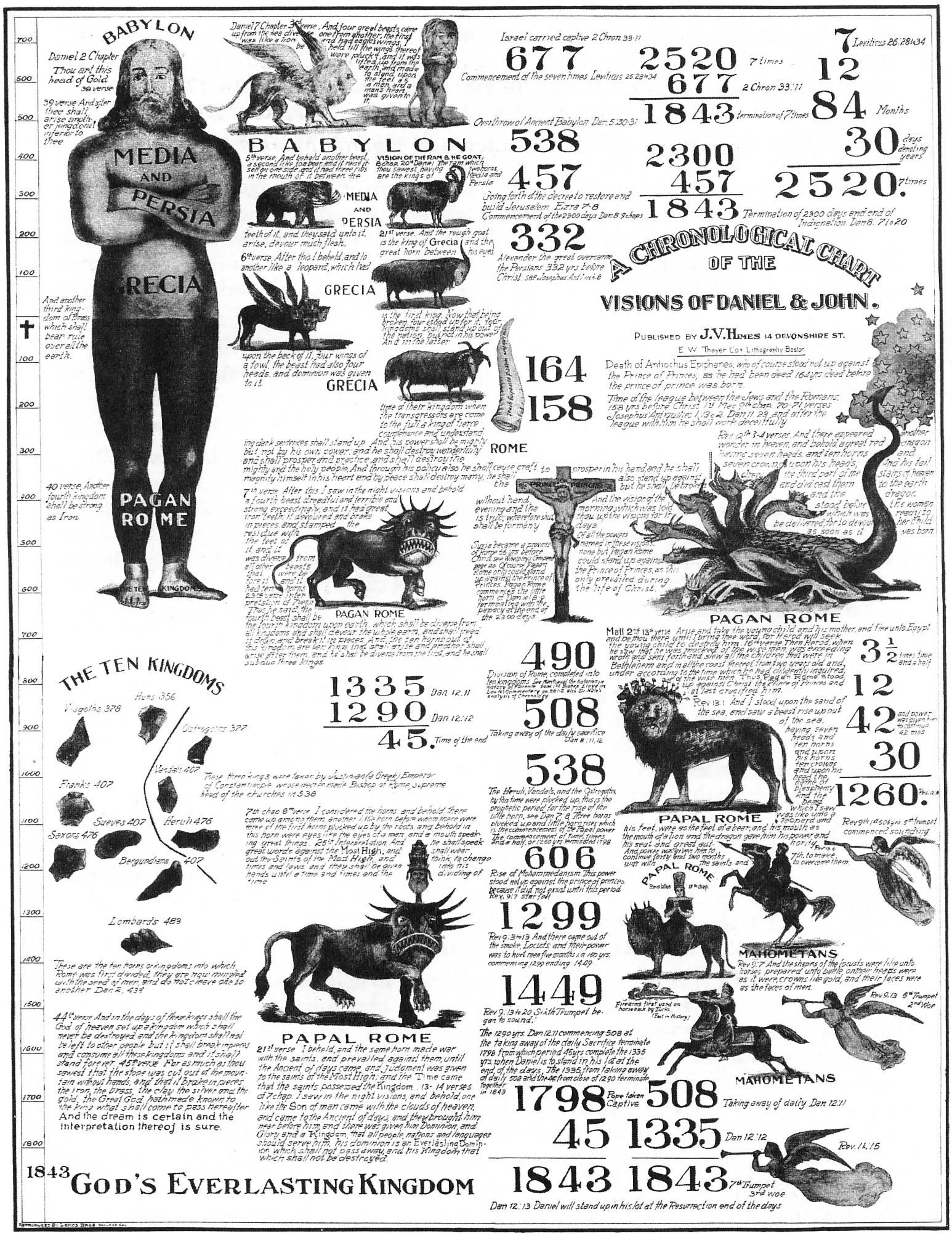
This refers to the date prophecies of Daniel, which are briefly summarised below. As mentioned above, please refer to what I have previously written on this topic, as well as Some Answered Questions by ‘Abdu’l-Bahá and Thief in the Night by William Sears for a more detailed explanation. You can also refer to the writings of William Miller (1782 – 1849), an American Baptist preacher whose followers became known as the Millerites, eventually inspiring the Seventh-day Adventist movement and other millenarian movements. It was William Miller who first concluded that the prophecy of Daniel leads us to the year 1844 AD. The Prophet Daniel writes:
‘Then I heard one saint speaking, and another saint said unto that certain saint which spake, How long shall be the vision concerning the daily sacrifice, and the transgression of desolation, to give both the sanctuary and the host to be trodden under foot? And he said unto me, Unto two thousand and three hundred days; then shall the sanctuary be cleansed.’[60]
Two thousand three hundred days refers to 2,300 years. In the Bible, according to Numbers 14:33 in the Torah, a day should signify one year: ‘each day for a year.’[61] Likewise, the Prophet Ezekiel writes that ‘I have appointed thee each day for a year.’[62] In 457 BC, the Persian Emperor, Artaxerxes, issued a decree, which is mentioned in the Bible (Ezra 7:12 - 13): ‘Artaxerxes, king of kings, unto Ezra the priest, a scribe of the law of the God of heaven, perfect peace, and at such a time. I make a decree, that all they of the people of Israel, and of his priests and Levites, in my realm, which are minded of their own freewill to go up to Jerusalem, go with thee.’ Ezra was a Priest and Scribe and the religious leader of the Jewish community in Babylon. Regarding the ‘transgression of desolation’, ‘Abdu’l-Bahá interprets this to mean ‘how long will this misfortune, this ruin, this abasement and degradation last?’[63] The sanctuary referred to here is the Temple, i.e. the Law of God and His Revelation. After 2,300 years, the Temple, i.e. the Law of God, will be cleansed and purified. This refers to the coming of the Day of God and the Promised One. There are 456 years from the decree of Artaxerxes (in 457 BC) to the birth of Christ and 1,844 years from the birth of Christ until the Declaration of Báb in 1844 AD (1260 AH). If we add 456 to 1844, we get 2,300, which is the exact number of years specified by the Prophet Daniel. This prophecy can only mean that the Day of God must have begun in the year 1844 AD.
In another prophecy, Daniel writes:
‘Seventy weeks are determined upon thy people and upon thy holy city, to finish the transgression, and to make an end of sins, and to make reconciliation for iniquity, and to bring in everlasting righteousness, and to seal up the vision and prophecy, and to anoint the most Holy.
‘Know therefore and understand, that from the going forth of the commandment to restore and to build Jerusalem unto the Messiah the Prince shall be seven weeks, and threescore and two weeks: the street shall be built again, and the wall, even in troublous times.’[64]
This refers to the time period after which the ‘holy city’ (i.e. the Word of God or Revelation of God) will be purified and ‘bring in everlasting righteousness’ and in which the “most Holy” will be anointed. The word Messiah means the one who is anointed, i.e. Jesus Christ. The Revelation of God is renewed every thousand years or so, e.g. from the time of Abraham to Moses and from Moses to Christ. The holy city, literally speaking, could refer to Jerusalem, which is the holiest city in Judaism. In the second verse (v. 25), the time period is given as 7 weeks and 62 weeks. The two amounts, 70 weeks and 7 + 62 weeks can be reconciled as follows. Seventy weeks is 7 x 70 days, which is 490 years. When you add the 7 weeks and 62 weeks, you get 69 weeks, and it is the 70th week that Jesus Christ was crucified. 70 weeks means 490 days, which are counted as 490 years. These should be counted from the decree of the Persian Emperor Artaxerxes if 457 BC, which we already mentioned above. 490 minus 457 equals 33. Add 33 years and you come to 33 AD, which is when Jesus Christ was martyred. He began His Ministry around 30 AD and was crucified by the Romans in 33 AD. Thus, the exact timing of the crucifixion of Jesus Christ was prophesied by the Prophet Daniel. Therefore, if this prophecy of Daniel exactly predicts the crucifixion of Christ in 33 AD, then the above prophecy of the 2,300 days must also be interpreted as leading to the year 1844 AD.
In another place, Daniel states that these things come to pass 3 and half days, referred to as a ‘time, times, and an half’.[65] Daniel said:
‘And I heard the man clothed in linen, which was upon the waters of the river, when he held up his right hand and his left hand unto heaven, and sware by him that liveth for ever that it shall be for a time, times, and an half; and when he shall have accomplished to scatter the power of the holy people, all these things shall be finished.’[66]
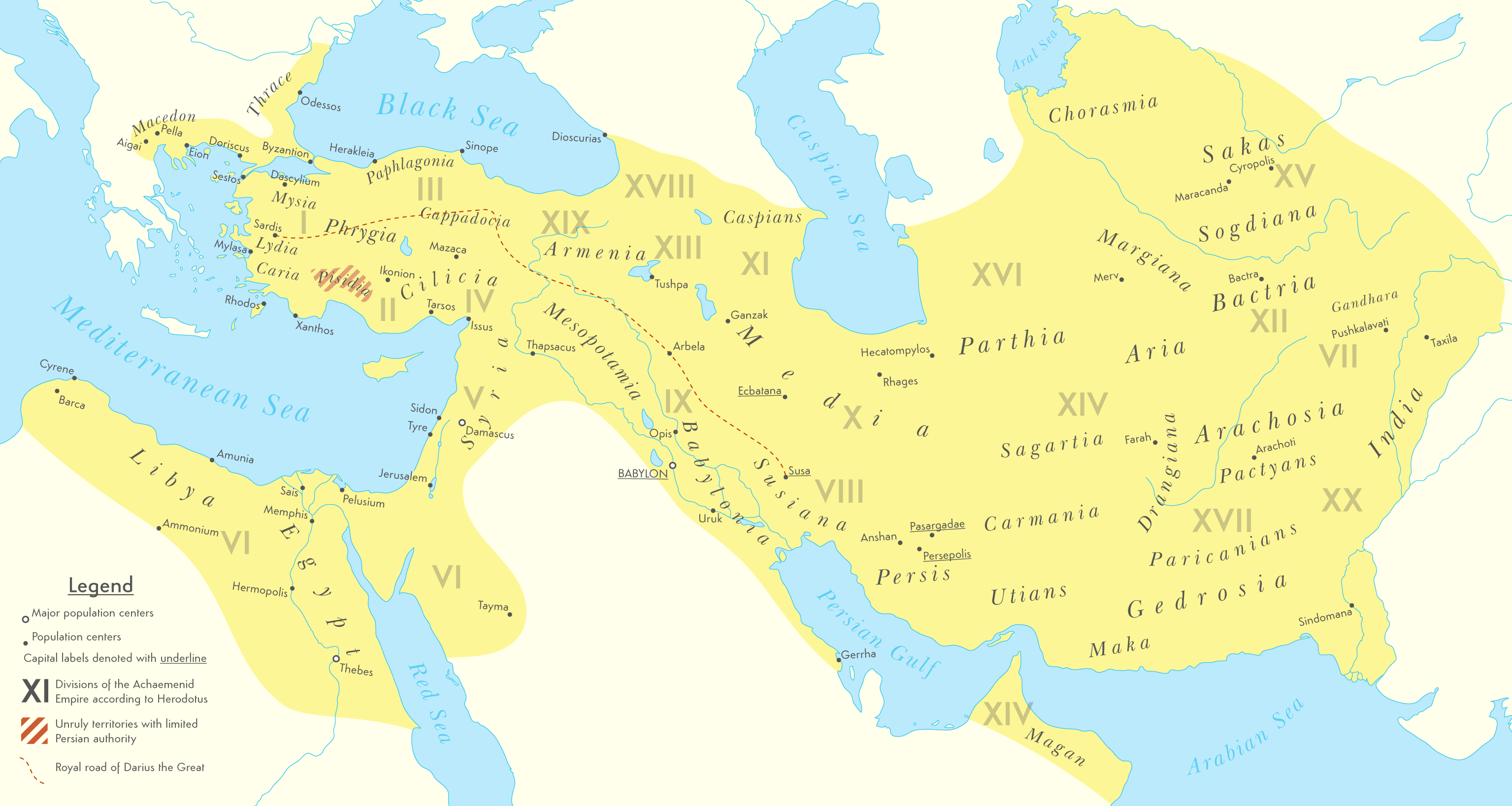
Three days and a half equals three years, which can be broken down into 42 months, and 42 months contain 1,260 days, which are 1,260 years. When do we count these 1,260 years from? The fact that we have already reached 1844 AD from 2,300 days gives us a clue. The year 1844 AD in the Gregorian calendar is 1260 AH in the Islamic lunar calendar. Thus the 1,260 days or years are the timespan of the Islamic calendar, from the Hegira of Muhammad until the dawn of the Day of God. The Hegira (Hijrah) took place in 622 AD and marks the journey of Muhammad and his followers from the city of Mecca, where they were being persecuted for proclaiming monotheism, to the city of Yathrib, now known as Medina. Muhammad left Mecca in May 622, along with his companion, Abú-Bakr. When they arrived in Yathrib, the nascent Muslim community began to take shape and begin to develop as the first Islamic state. Islam would eventually spread and take over the Middle East, including the Persian Empire where Daniel received his revelations. These revelations particularly took place in Mesopotamia, between the two rivers, the Tigris and the Euphrates.
At the time, Daniel did not understand these prophecies, nor did anyone decipher them, until the time that the minister William Miller came to the conclusion that these refer to 1844 AD. Why were people unable to understand these prophecies until the 19th century? This is explained by Daniel himself in the next verse:
‘And I heard, but I understood not: then said I, O my Lord, what shall be the end of these things? And he said, Go thy way, Daniel: for the words are closed up and sealed till the time of the end.’[67]
The fact that we can now unlock these prophecies is a sign that the end has come, and Christ has indeed returned.
There is a third year that is mentioned by the Prophet Daniel. He said:
‘And from the time that the daily sacrifice shall be taken away, and the abomination that maketh desolate set up, there shall be a thousand two hundred and ninety days.’[68]
The question is where to begin counting these 1,290 days from. As with the 1,260 years, this refers to years within the lunar calendar, dating back to the Prophet Muhammad. The reason for this is because Christ would return within the land of Elam, as prophesied by the Prophet Jeremiah (49:38), which is the land of Persia where Daniel received his revelations. Moreover, as we shall see below, the Return of Christ is also referred to as Michael, the Prince of Persia. The calendar in use in Persia in 1844 AD was the Islamic lunar calendar. However, the 1,290 days date from the revelation of Muhammad, rather than from the Hegira. The Prophet Muhammad received His first revelation in 610 AD (13 B.H.), so He would have openly proclaimed His mission in c. 612/613 AD (10 B.H.). This proclamation occurred 10 lunar years before the Hegira (which occurred in June/July of 622 AD or 1 A.H.). The Hegira year 1 is equivalent to 15/16 July 622 AD – 3/4 July 623 AH. If you add 1,290 years from the revelation of Muhammad, you reach the Islamic year of 1,279 AH, which is 29 June 1862 – 18 June 1863 AD. Thus, something very important must have happened in the year 1862/1863 AD. Thus, we have three important dates, 33 AD, when the Messiah would be cut off (i.e. Jesus Christ was crucified), 1844 AD when the sanctuary would be cleansed (i.e. Day of God would begin), and 1863 AD (1279 AH) when Michael, ‘the great prince which standeth for the children of thy people’ (Daniel 12:1) shall be made manifest, and the ‘end of these wonders’ shall come to pass (Daniel 12:6). Who is Michael? In Daniel 10:13, we are told that ‘lo, Michael, one of the chief princes, came to help me; and I remained there with the kings of Persia.’[69] Michael is ‘one of the chief princes’ of Persia, which is the empire that Daniel was living in at the time. Michael is derived from the Hebrew mī kāʼēl, meaning ‘Who is like God (El)?’, meaning that Michael is a Being ‘like God’ or a Manifestation of God, i.e. the Second Coming of Christ. This is the same individual foretold by the Prophet Isaiah, who said: ‘For unto us a child is born, unto us a son is given: and the government shall be upon his shoulder: and his name shall be called Wonderful, Counsellor, The mighty God, The everlasting Father, The Prince of Peace.’[70]

After speaking of the fate of Judea (as it would suffer under the Romans), and warning of the coming of false prophets and Messiahs, such as Simon bar Kokhba, Jesus further told His disciples:
‘For as the lightning cometh out of the east, and shineth even unto the west; so shall also the coming of the Son of man be.’[122]
This indicates that the Return of Christ will be sudden, like lightning, and that He will come ‘out of the east’ and shine ‘even unto the west’. This indicates, again, that Christ will appear from the east of Judea, i.e. in Persia and Mesopotamia, and then travel to the west, e.g. to west of Judea. This is important to consider in terms of the location of the Returned Christ when He reappears.
Jesus further says:
‘Immediately after the tribulation of those days shall the sun be darkened, and the moon shall not give her light, and the stars shall fall from heaven, and the powers of the heavens shall be shaken: And then shall appear the sign of the Son of man in heaven: and then shall all the tribes of the earth mourn, and they shall see the Son of man coming in the clouds of heaven with power and great glory. And he shall send his angels with a great sound of a trumpet, and they shall gather together his elect from the four winds, from one end of heaven to the other.’[123]
These are key verses in the Christian conception of the Return of Christ, because they refer to Christ coming in the clouds of heaven ‘with power and great glory’ and with ‘a great sound of a trumpet’.[124] Taken literally, this is something that everyone would recognise instantly and there would be no doubt. But as we know from the first Coming of Christ, scriptural prophecy should not be taken literally, nor does God do miracles for the purpose of proving Himself to people, for, as Jesus said: ‘A wicked and adulterous generation seeketh after a sign.’[125] Christ appearing in this miraculous way would defeat the purpose of faith. Likewise, as we know that the physical resurrection of Christ and ascent to heaven would make no logical sense, since ‘It is the spirit that quickeneth; the flesh profiteth nothing: the words that I speak unto you, they are spirit, and they are life,’[126] and ‘… flesh and blood cannot inherit the kingdom of God; neither doth corruption inherit incorruption,’[127] it is clear that Jesus could not return in the same body, and with the same personality, individuality, spirit and person as before. Rather, it is the quality, authority and power of Christ that returns with the Glory of His Father, i.e. Michael, the Prince of Persia, referred to above in the prophesy of Daniel. So, there must be a symbolic meaning to the verses from the Gospel of Matthew mentioned above.
Now, we know that the book has been sealed until the time of the end, but now the seals have been broken and we can understand these prophecies. As the book of Revelation states: ‘And I saw in the right hand of him that sat on the throne a book written within and on the backside, sealed with seven seals.’[128] The meanings of these prophecies are explained in detail in two fascinating and inspiring books, the Book of Certitude, mentioned earlier, and Gems of Divine Mysteries, both authored by Bahá’u’lláh. In the Book of Certitude, Bahá’u’lláh explains the above verses from the New Testament:
‘At that time, the signs of the Son of man shall appear in heaven, that is, the promised Beauty and Substance of life shall, when these signs have appeared, step forth out of the realm of the invisible into the visible world. And He saith: at that time, all the peoples and kindreds that dwell on earth shall bewail and lament, and they shall see that divine Beauty coming from heaven, riding upon the clouds with power, grandeur, and magnificence, sending His angels with a great sound of a trumpet. Similarly, in the three other Gospels, according to Luke, Mark, and John, the same statements are recorded…
‘As to the words—“Immediately after the oppression of those days” [129]—they refer to the time when men shall become oppressed and afflicted, the time when the lingering traces of the Sun of Truth and the fruit of the Tree of knowledge and wisdom will have vanished from the midst of men, when the reins of mankind will have fallen into the grasp of the foolish and ignorant, when the portals of divine unity and understanding—the essential and highest purpose in creation—will have been closed, when certain knowledge will have given way to idle fancy, and corruption will have usurped the station of righteousness. Such a condition as this is witnessed in this day when the reins of every community have fallen into the grasp of foolish leaders, who lead after their own whims and desire…
‘What “oppression” is more grievous than that a soul seeking the truth, and wishing to attain unto the knowledge of God, should know not where to go for it and from whom to seek it? For opinions have sorely differed, and the ways unto the attainment of God have multiplied. This “oppression” is the essential feature of every Revelation. Unless it cometh to pass, the Sun of Truth will not be made manifest. For the break of the morn of divine guidance must needs follow the darkness of the night of error…
‘‘And now, concerning His words—“The sun shall be darkened, and the moon shall not give light, and the stars shall fall from heaven.”[130] By the terms “sun” and “moon,” mentioned in the writings of the Prophets of God, is not meant solely the sun and moon of the visible universe. Nay rather, manifold are the meanings they have intended for these terms. In every instance they have attached to them a particular significance. Thus, by the “sun” in one sense is meant those Suns of Truth Who rise from the dayspring of ancient glory, and fill the world with a liberal effusion of grace from on high. These Suns of Truth are the universal Manifestations of God in the worlds of His attributes and names. Even as the visible sun that assisteth, as decreed by God, the true One, the Adored, in the development of all earthly things, such as the trees, the fruits, and colors thereof, the minerals of the earth, and all that may be witnessed in the world of creation, so do the divine Luminaries, by their loving care and educative influence, cause the trees of divine unity, the fruits of His oneness, the leaves of detachment, the blossoms of knowledge and certitude, and the myrtles of wisdom and utterance, to exist and be made manifest. Thus it is that through the rise of these Luminaries of God the world is made new, the waters of everlasting life stream forth, the billows of loving-kindness surge, the clouds of grace are gathered, and the breeze of bounty bloweth upon all created things. It is the warmth that these Luminaries of God generate, and the undying fires they kindle, which cause the light of the love of God to burn fiercely in the heart of humanity. It is through the abundant grace of these Symbols of Detachment that the Spirit of life everlasting is breathed into the bodies of the dead. Assuredly the visible sun is but a sign of the splendor of that Daystar of Truth, that Sun Which can never have a peer, a likeness, or rival. Through Him all things live, move, and have their being. Through His grace they are made manifest, and unto Him they all return. From Him all things have sprung, and unto the treasuries of His revelation they all have repaired. From Him all created things did proceed, and to the depositories of His law they did revert…
‘Hence, it is clear and manifest that by the words “the sun shall be darkened, and the moon shall not give her light, and the stars shall fall from heaven” is intended the waywardness of the divines, and the annulment of laws firmly established by divine Revelation, all of which, in symbolic language, have been foreshadowed by the Manifestation of God. None except the righteous shall partake of this cup, none but the godly can share therein… It is unquestionable that in every succeeding Revelation the “sun” and “moon” of the teachings, laws, commandments, and prohibitions which have been established in the preceding Dispensation, and which have overshadowed the people of that age, become darkened, that is, are exhausted, and cease to exert their influence…
‘And now, concerning His words: “And then shall appear the sign of the Son of man in heaven.”[131] By these words it is meant that when the sun of the heavenly teachings hath been eclipsed, the stars of the divinely established laws have fallen, and the moon of true knowledge—the educator of mankind—hath been obscured; when the standards of guidance and felicity have been reversed, and the morn of truth and righteousness hath sunk in night, then shall the sign of the Son of man appear in heaven. By “heaven” is meant the visible heaven, inasmuch as when the hour draweth nigh on which the Daystar of the heaven of justice shall be made manifest, and the Ark of divine guidance shall sail upon the sea of glory, a star will appear in the heaven, heralding unto its people the advent of that most great light. In like manner, in the invisible heaven a star shall be made manifest who, unto the peoples of the earth, shall act as a harbinger of the break of that true and exalted Morn. These twofold signs, in the visible and the invisible heaven, have announced the Revelation of each of the Prophets of God, as is commonly believed.
‘And now regarding His words, that the Son of man shall “come in the clouds of heaven.” By the term “clouds” is meant those things that are contrary to the ways and desires of men… These “clouds” signify, in one sense, the annulment of laws, the abrogation of former Dispensations, the repeal of rituals and customs current amongst men, the exalting of the illiterate faithful above the learned opposers of the Faith. In another sense, they mean the appearance of that immortal Beauty in the image of mortal man, with such human limitations as eating and drinking, poverty and riches, glory and abasement, sleeping and waking, and such other things as cast doubt in the minds of men, and cause them to turn away. All such veils are symbolically referred to as “clouds.”
‘These are the “clouds” that cause the heavens of the knowledge and understanding of all that dwell on earth to be cloven asunder. Other Prophets, similarly, have been subject to poverty and afflictions, to hunger, and to the ills and chances of this world. As these holy Persons were subject to such needs and wants, the people were, consequently, lost in the wilds of misgivings and doubts, and were afflicted with bewilderment and perplexity. How, they wondered, could such a person be sent down from God, assert His ascendancy over all the peoples and kindreds of the earth, and claim Himself to be the goal of all creation…
‘And now, concerning His words: “And He shall send His angels.…”[132] By “angels” is meant those who, reinforced by the power of the spirit, have consumed, with the fire of the love of God, all human traits and limitations, and have clothed themselves with the attributes of the most exalted Beings and of the Cherubim… And now, inasmuch as these holy beings have sanctified themselves from every human limitation, have become endowed with the attributes of the spiritual, and have been adorned with the noble traits of the blessed, they therefore have been designated as “angels.” Such is the meaning of these verses, every word of which hath been expounded by the aid of the most lucid texts, the most convincing arguments, and the best established evidences.’[133]
In terms of physical signs of the Second Coming, the following are a few examples: On January 1, 1837, an earthquake hit Galilee in Palestine, killing 6,000 – 7,000 people and, in June 1838, an earthquake hit San Francisco.[134] Another earthquake hit Fars in 1854 (killing 40,000).[135] In 1833 and 1866, there were massive star-falls. On 13 November 1833, there were 34,640 falling stars per hour, with North America receiving the brunt of the star fall.[136] Also, the grandest star shower ever observed in Britain occurred on 13 November 1866. The total number of meteors estimated to have fallen was 240,000.[137] Biela’s comet, which split into two, heralded both the Declaration of the Báb and the Revelation of Bahá’u’lláh, appearing in 1805, 1826, 1832, 1846 and 1852 AD.[138] Biela’s comet is a periodic ‘Jupiter-family comet’ first recorded on 8 March 1772. It has not been seen since 1852 and is currently believed to be destroyed.[139] It is likely that Biela’s comet is the physical manifestation of the ‘sign of the Son of man’ which Jesus prophesied in Matthew 24:30. In 1819, likewise, the year of the birth of the Báb, there appeared the Great Comet of 1819, known as Comet Tralles, observed on 1 July 1819,[140] and the Pons-Winnecke Comet, observed 12 June 1819.[141] There was a total solar eclipse on 28 September 1819,[142] and a partial solar eclipse on 19 October 1819, and the Báb was born on 20 October 1819 in Shiraz, Persia. Likewise, a few years earlier, on 5 April 1815, the Mount Tambora eruption occurred, which was the most destructive explosion on Earth in the last 10,000 years, spewing ‘100 cubic kilometers (24 cubic miles) of gasses, dust, and rock into the atmosphere and the surrounding area’ and ending in 1818.[143] This led to the ‘Year Without Summer’ in 1816, caused by a volcanic winter. Moreover, there were three lunar eclipses in 1817, on 1 & 30 May 1817 and 23 November 1817,[144] as well as a total solar eclipse on 9 November 1817.[145] Three days later, Bahá’u’lláh was born on 12 November 1817 in Tehran, Persia.
The Lord of the Vineyard and Spirit of Truth
In the above, we have established that the Biblical concept of return refers to quality, power and authority, not to individuality. We know that physical ascent to a spiritual kingdom is impossible and resurrection refers to being born again to a new, spiritual life. It does not refer to resurrection of a material body. Moreover, life and death refer to the life and death of the spirit, not the body. Thus, we know that, as Elijah and John the Baptist are separate persons, but one return, so, likewise, Jesus and His Return in the Glory of the Father are separate Persons, but one return. The Prophet Daniel refers to this Return of Christ in various ways, including as Michael, the Prince of Persia, and as the Ancient of Days. The other Old Testament Prophets also use various terms to refer to the Return of Christ, including the Lord of Hosts, Everlasting Father, and Prince of Peace. In addition, He is the Seed of Jesse, a term which primarily applies to the Second Coming, not the First.
Table 1. Jesse to Zerubbabel

Table 2. Zerubbabel to lines of Exilarchs

Table 3. Line to Jesus and Kings of Persia

Jesus was the Son of Mary, not the Son of Joseph, though it is likely that Joseph and Mary were related. Jesus was born of a virgin, so He had no biological father, and, as such, was of Mary’s family and lineage. Mary likely had ancestry from both the Tribe of Judah and Tribe of Levi.[96] Some commentaries interpret Luke’s genealogy as referring to Mary’s direct ancestors, which would make her from the line of Jesse.[97] Jesus, nevertheless, referred to Himself as the Son, or the Son of Man, and acknowledged that He was the Son of God, whereas the Lord of Hosts is called the Everlasting Father. Jesus is Emmanuel (‘God with us’), born of a virgin, the Son of God, but His Return is Michael (‘The One Who is like God’)—the Ancient of Days, Yahweh Sabaoth. Jesus is the Messiah and High Priest (Hebrews 8:1),[98] whereas the Return of Christ is the King of Kings and Lord of Hosts, and is called Michael, the Prince of Persia. As such, while Jesus comes from the kingly line of David and the priestly line of Aaron—both via His mother (as He has no male line), the Return of Christ comes from both the royal line of David and the Royal House of Persia. The First Coming of the Messiah comes from the City of Bethlehem, while the Second Coming of the Messiah, who is the Ancient of Days, sets His throne in Elam,[99] and appears on the River Tigris in Mesopotamia,[100] as He appeared to Daniel by that river in 535 BC, during the reign of Cyrus the Great, King of Persia.[101] Further on in this article, there are tables showing how the Second Coming of Christ descends not only from Jesse but from the Kings of Persia, and is thus a Persian Mīrzā (mīr-zādeh) or ‘Prince of Persia’.
In the above prophecy from the Gospel of Matthew, Jesus referred to His own return, and the signs that would precede it, including references to the prophecy of Daniel, which gives us the exact years 33 AD, 1844 AD and 1863 AD, all of which are significant. Elsewhere in the Gospel of Matthew, Jesus says: ‘For the Son of man shall come in the glory of his Father with his angels; and then he shall reward every man according to his works.’[102] This is another clue that the Return of Christ will be a different Person, as Jesus of Nazareth came in the station of the Son of Man or Son of God, whereas, in His Return, He comes in the station of the Glory of His Father, i.e. as the Everlasting Father Himself. Jesus elsewhere refers to this Person as someone other than Himself. He says, in the Gospel of John, for example: ‘Ye have heard how I said unto you, I go away, and come again unto you,’[103] and ‘And I will pray the Father, and he shall give you another Comforter, that he may abide with you for ever; Even the Spirit of truth; whom the world cannot receive, because it seeth him not, neither knoweth him: but ye know him; for he dwelleth with you, and shall be in you. I will not leave you comfortless: I will come to you.’[104] Here, He says that He will send ‘another Comforter’, i.e. like Himself, who is the ‘Spirit of Truth’. This is often interpreted as a reference to the Holy Spirit. This is because, in John 14:26, He says (in the King James Version): ‘But the Comforter, which is the Holy Spirit (to Pneuma to Hagion)…’ However, the oldest surviving manuscript of the Bible, the Codex Sinaiticus, produced around 350 AD, does not include the word ‘which is the Holy Spirit’ before Spirit in John 14:26.[105] It says, in Greek, ο δε παρακλητοϲ πεμψει το πνα το αγιον ο πατηρʼ εν τω ονοματι μου ('But the Comforter [Paraklētos], whom the Father will send in My Name…’). This Comforter, or Paraklētos in Greek, is not an invisible spirit. Jesus associates His coming with His own return, saying ‘I will come to you’.[106] Jesus is the Comforter, but He is also ‘another Comforter’ who will come to them in His Return. Another objection is that the Spirit of Truth, according to John 14:17, is not seen by the world, but dwells in His disciples. He is not seen, for the same reason that Jesus would not be seen following John 14:19. Jesus would be crucified and leave this world, and the Spirit of Truth would come centuries later. He dwells in the believers, just as Christ dwells in the believers. In John 14:20, Jesus says: ‘At that day ye shall know that I am in my Father, and ye in me, and I in you.’[107] Likewise, the Return of Christ also dwells within those who believe in Him.
Further confirmation that the Spirit of Truth is another person can be found in the John, chapter 16. Jesus says that He has many things to say to His disciples, but they are not ready to hear them now. This indicates that the Message of Jesus was for a particular time and setting, and that His immediate disciples would not be able to comprehend a further Message of truth. Rather, after the passage of many centuries, they would be ready for additional teachings and a greater measure of knowledge and understanding. Jesus said: ‘I have yet many things to say unto you, but ye cannot bear them now. Howbeit when he, the Spirit of truth, is come, he will guide you into all truth: for he shall not speak of himself; but whatsoever he shall hear, that shall he speak: and he will shew you things to come. He shall glorify me: for he shall receive of mine, and shall shew it unto you.’[108] This refers to the Spirit of Truth as a Person who will come to the world at a future date and reveal greater truth. That Person will speak the Word of God, and will glorify Jesus Christ. In the next verse, Jesus then again connects this with His own Return, saying ‘A little while, and ye shall not see me: and again, a little while, and ye shall see me, because I go to the Father.’ In other words, He will disappear after His ascent to heaven, and then will return again as the Spirit of Truth many centuries later on, in accordance with the prophecy of Daniel, i.e. in 1863 AD.
Beside the three Names already mentioned, that is ‘the Glory of His Father’, ‘the Spirit of Truth’ and ‘the Comforter’, Jesus also refers to His Return by another name. This is found in the Parable of the Vineyard, which is related in the Gospels. The following is from the Gospel of Matthew:
‘Hear another parable: There was a certain householder, which planted a vineyard, and hedged it round about, and digged a winepress in it, and built a tower, and let it out to husbandmen, and went into a far country: And when the time of the fruit drew near, he sent his servants to the husbandmen, that they might receive the fruits of it. And the husbandmen took his servants, and beat one, and killed another, and stoned another.
‘Again, he sent other servants more than the first: and they did unto them likewise. But last of all he sent unto them his son, saying, They will reverence my son. But when the husbandmen saw the son, they said among themselves, This is the heir; come, let us kill him, and let us seize on his inheritance. And they caught him, and cast him out of the vineyard, and slew him.
‘When the lord therefore of the vineyard cometh, what will he do unto those husbandmen?
‘They say unto him, He will miserably destroy those wicked men, and will let out his vineyard unto other husbandmen, which shall render him the fruits in their seasons.
‘Jesus saith unto them, Did ye never read in the scriptures, The stone which the builders rejected, the same is become the head of the corner: this is the Lord's doing, and it is marvellous in our eyes?
‘Therefore say I unto you, The kingdom of God shall be taken from you, and given to a nation bringing forth the fruits thereof.’[109]
The ‘vineyard’ here refers to Israel, and the Lord of the Vineyard is the Lord of Hosts, the Promised Return of Christ. The servants are the various Prophets being sent to Israel, who were beaten, killed, stoned and rejected. Then God sends the Son, who is Jesus of Nazareth, and they killed the Son. Then the Lord of the Vineyard Himself comes to punish the wicked and render good fruits to the righteous. Jesus then follows this up by clarifying that the Kingdom of God would be taken from the Israelites and given to ‘a nation bringing forth the fruits thereof’.[110] The Lord of the Vineyard is the Return (Parousia) of Christ, the other ‘nation’ is Persia, as we know from the Book of Daniel that Michael is the one of the Chief Princes of Persia. Persia here is the stone which the builders rejected. In another sense, the ‘nation’ here refers to the followers of the Return of Christ, who will be another group of people other than the Israelites, i.e. a new people born of their worship of the Return of Christ. The Lord of the Vineyard here is the Father, the Lord of Hosts, whereas Jesus in His First Coming was the Son of Man or Son of God. The Prophet Isaiah refers to Him in these words as having a red garment because He is ‘Him that treadeth in the winefat’ who ‘will tread them in mine anger, and trample them in my fury; and their blood shall be sprinkled upon my garments, and I will stain all my raiment.’[111] Likewise, in the Book of Revelation, we are told that ‘he was clothed with a vesture dipped in blood: and his name is called The Word of God.’[112] This indicates several additional things: i.e. that He will often wear a red garment and that He is associated with a vineyard, i.e. with Mount Carmel in Israel. Carmel literally means ‘vineyard of God (El)’, which is therefore the Mountain of the ‘One who is like El’, i.e. Michael. As Isaiah prophesied: ‘It shall blossom abundantly, and rejoice even with joy and singing: the glory of Lebanon shall be given unto it, the excellency of Carmel and Sharon, they shall see the glory of the Lord, and the excellency of our God.’[113] In other words, the Return of Christ will appear on the plain of Sharon and ascend Mount Carmel. He will also be near to Lebanon.
Conclusion
Taking all of this together leads to one inescapable conclusion, as there is only one Person who meets all the qualifications listed in this article, i.e. Bahá’u’lláh (1817 – 1892). He was born in 1817 AD in Tehran, the capital of Persia, which is associated with ancient Elam. Tehran is located near the ancient city of Ray or Rhages. He was a nobleman and son of a government minister, but His direct male-line belonged to a branch of the Bádúspánid (or Pádúspánid) dynasty, an Iranian dynasty based in Tabaristan and which ruled over Ruyan (later known as Rustamdar) between 665 AD and 1598 AD.[114] See the tables below which show this extraordinary descent. As mentioned above, while Jesus was descended through His mother from both Jesse and Aaron, and He was the Messiah and High-Priest expected in Jewish prophesies, as well as the Son of Man, the Second Coming of Christ is referred to as Michael, the Prince of Persia, as well as the Seed of Jesse. When Christ returns, therefore, He must be from both the lineage of Jesse and that of the Kings of Persia.
Table 4. The Sassanian Dynasty and their connection with the House of David

The Bádúspánid dynasty was itself descended in the male line from King Jámásp (Djamasp), King of Kings of Persia (r. 496 to 498/9 AD), and was thus a branch of the Sassanid (Sassanian) Royal Family. Bahá’u’lláh was thus a Prince of Persia. This is confirmed by His given name, Mírzá Husayn-‘Alí Núrí. Mírzá is an abbreviation of mír-zádeh ‘son of the Master’, indicating someone of princely lineage. Bahá’u’lláh is Michael, the Prince of Persia. Bahá’u’lláh’s ancestor, Yazdigird (Yazdegerd) I, King of Kings of Persia (r. 399 – 420 AD), married a woman called Shushandukht,[165] who was a daughter of Huna III, the Jewish Exilarch (4th century CE),[166] a direct descendant of Jeconiah, King of Judah (r. 598 – 597 BC), and thus a descendant of Jesse. She gave birth to Yazdigird I’s son and heir, Bahrám V Gúr. Bahá’u’lláh is thus the Seed of Jesse referred to in the Book of Isaiah. For more information on Bahá’u’lláh’s direct family, see the chart in Volume V of The Bahá’í World,[167] or Bahá’u’lláh: The King of Glory by HM Balyuzi.
Table 5. The Sassanians Part II, and the Baduspanid Dynasty, part I

Table 6. The Baduspanids, Rulers of Ruyan, Persia, part II (continued)

Table 7. The Baduspanids, Rulers of Ruyan, Persia, part III (continued)

Table 8. Line to the Promised One, The Lord of Hosts, Bahá’u’lláh (The Glory of God)

The Báb (1819 – 1850) proclaimed, on the 22nd of May 1844 AD, that He was the Gate of God (Bábu’lláh) and the Forerunner of One Greater than Himself, just as John the Baptist had proclaimed that Jesus would be greater than He. The Day of God thus began in 1844 AD in Shiraz, as prophesied in the Book of Daniel. Moreover, Shiraz, in the heartland of Persia, is located in the territory of the ancient Elamite civilisation. The Báb was, like John the Baptist, also the Return of Elijah (Elias). Mírzá Husayn-‘Alí became a disciple of the Báb in 1844, and the Báb directed His first letter to Mírzá Husayn-‘Alí, delivery of which was the first mission of His disciple Mullá Husayn. In 1848, at the Conference of Badasht, a gathering of followers of the Báb to determine the future of the Bábí religion, Mírzá Husayn-‘Alí took upon Himself a new name, Bahá’ (Arabic for ‘Glory’ or ‘Splendour’). This was in fulfilment of the numerous prophecies of the Old and New Testaments calling the Promised One the ‘Glory of God’ or the ‘Glory of His Father’ or the ‘King of Glory’. The Prophet Isaiah wrote that ‘the Gentiles shall see thy righteousness, and all kings thy Glory: and thou shalt be called by a new name, which the mouth of the Lord shall name.’[168] This new name is Bahá’ or ‘Glory’, as referred to in the verse itself. Likewise, in the Book of Revelation, we are told that His followers will also take up this new name: ‘He that hath an ear, let him hear what the Spirit saith unto the churches; To him that overcometh will I give to eat of the hidden manna, and will give him a white stone, and in the stone a new name written, which no man knoweth saving he that receiveth it.’[169] This is because the followers of the Promised One will be called Bahá’ís, which is a new name. The Báb later confirmed this name and the other names given by Bahá’u’lláh to those present at the Conference of Badasht. Bahá’u’lláh means the ‘Glory of God’ or ‘Splendour of God’. Like John the Baptist, the Báb was executed in 1850, although this execution more resembled the crucifixion of Christ than it did the execution of John.
Bahá’u’lláh received His Revelation from God in October 1852 AD, while imprisoned in the Black Pit of Tehran. Then, after being exiled to Baghdad, on the Tigris River in Mesopotamia, the same river on which the Prophet Daniel had received his revelations recorded in chapter 10 of the Book of Daniel.[170] On the 21st of April 1863 AD, in line with the prophecy of Daniel, Bahá’u’lláh proclaimed that He was the One prophesied by the Báb and the Promised One of all ages and all scriptures, Him Whom God shall make manifest. He was the Return of Christ in the Glory of His Father and the Prince of Peace. In fact, the primary mission of Bahá’u’lláh is the establishment of world peace and the unification of mankind, as promised in the Book of Isaiah and all the prophecies of the Old Testament. In contrast, Jesus said: ‘Think not that I am come to send peace on earth: I came not to send peace, but a sword.’[171] Likewise, Jesus said: ‘Then said he unto them, But now, he that hath a purse, let him take it, and likewise his scrip: and he that hath no sword, let him sell his garment, and buy one.’[172] In contrast, in April 1863, Bahá’u’lláh, as the Prince of Peace, abolished the concept of holy war and forbade His followers to carry a weapon. In His Most Holy Book, He also forbade the trading and ownership of slaves and called upon the leaders of the world to accept the Most Great Peace, which is the spiritual and material unification of mankind. Since they refused to accept this peace, mankind has suffered numerous calamities since that time, which were prophesied in His Writings. He also said that the Most Great Peace was an inevitability and would come once His Teachings had embraced most (and eventually all) of mankind. This would be preceded by the Lesser Peace, which is the end of warfare and material unification of the world. His followers, called Bahá’ís, are endeavouring to spread His Message and Teachings across the world.

Original entrance to the Black Pit of Tehran
One may object, but is this not ‘another Christ’, or a false Messiah, or a false Prophet? And how can one stop following Christ and follow Bahá’u’lláh? Or is it not a betrayal to become a Bahá’í if one is a Christian? The answer to that is no, and one does not stop following Christ. Christ Himself made this clear by giving us signs of His coming, as already mentioned above, including that the Gospel would be preached first to all the world, ending in the 19th century, and that the Day of God would begin in 1844 with the Declaration of the Báb and that Christ Himself would return in 1863 in the Person of the Spirit of Truth, the Lord of the Vineyard, the Glory of His Father, bearing the New Name of the Glory of God (i.e. Bahá’u’lláh). Christ distinguishes false from true Prophets by saying: ‘Ye shall know them by their fruits. Do men gather grapes of thorns, or figs of thistles? Even so every good tree bringeth forth good fruit; but a corrupt tree bringeth forth evil fruit. A good tree cannot bring forth evil fruit, neither can a corrupt tree bring forth good fruit. Every tree that bringeth not forth good fruit is hewn down, and cast into the fire. Wherefore by their fruits ye shall know them.’[174] Thus by Bahá’u’lláh’s fruits alone we can know that He is a true Prophet. Likewise, accepting Bahá’u’lláh does not mean rejecting Christ, because Jesus of Nazareth and Bahá’u’lláh are one. To truly accept Christ is to accept Bahá’u’lláh, and to reject Bahá’u’lláh is to reject Christ. In this day and age, one cannot accept one and reject the other—both Jesus and Bahá’u’lláh must be accepted in order for one to be a true believer, because they are one.
Jesus came in the station of the Son of God. Bahá’u’lláh came in the station of the Father. Jesus says that He and the Father are one, i.e. that He and Bahá’u’lláh should be regarded as one and the same. He said: ‘My Father, which gave them me, is greater than all; and no man is able to pluck them out of my Father's hand. I and my Father are one.’[175] Thus the Father (Bahá’u’lláh) and the Son (Jesus) are one in purpose and quality. He also says: ‘If I do not the works of my Father, believe me not. But if I do, though ye believe not me, believe the works: that ye may know, and believe, that the Father is in me, and I in him.’[176] In one sense, Father here refers to God, as God is the Father of the universe. In the other sense, as the Prophet Isaiah tells us, the Promised One is called the ‘Everlasting Father’. Isaiah writes that ‘For unto us a child is born, unto us a son is given: and the government shall be upon his shoulder: and his name shall be called Wonderful, Counsellor, The mighty God, The everlasting Father, The Prince of Peace.’[177] This is referring to Bahá’u’lláh, who is the ‘everlasting Father’ referred to here. Thus ‘Father’ does not just refer to God, but to the One who is a pure Mirror and Representative of God, who does the actions of God and is His Mouthpiece. While neither Jesus nor Bahá’u’lláh are literally God in the sense of being of the same essence of God (a mistaken dogma of the church councils), they are both divine in the sense that they are pure Mirrors of God, reflecting all of His attributes in absolute perfection, and Jesus and Bahá’u’lláh differ only in the intensity of their revelation and their particular mission. Thus Jesus took upon Himself the title of the Son of Man and the Son of God, while Bahá’u’lláh came in the Glory of His Father, and is thus called ‘the Father’ by Jesus. The implication of the story of the Lord of the Vineyard, likewise, is that the Father of the Son who is killed is the Lord of the Vineyard, who will come. Thus, if we take this literally, Jesus would return as His own Father, which makes no sense, as Christians believe that Jesus is God made flesh and He has already come in the station of the Son. How can He also be the Father? This only makes sense if we abandon the concept of the Father and Son being ‘of one essence’, which is a concept influenced by Greek philosophy, and instead understand that both the Son and the Father are two stations in which Messengers of God appear. While God Himself is the Everlasting Father, He also allows His Messenger to appear in the station of the ‘Everlasting Father’, because He is the perfect Mirror and Representative of the ‘Everlasting Father’ in heaven.
Likewise, Jesus says: ‘Jesus saith unto him, I am the way, the truth, and the life: no man cometh unto the Father, but by me.’[178] This applies to Jesus because He came in the station of the Son. This also applies to Bahá’u’lláh because He is the Return of Christ in the Glory of His Father. Jesus then goes on to say: ‘If ye had known me, ye should have known my Father also: and from henceforth ye know him, and have seen him.’[179] This has several meanings. In the first sense, those who know Jesus know God, because God manifests Himself through the Person of Jesus of Nazareth. While Jesus isn’t one in essence with God, He is one with God in the sense that all of God’s attributes, power and authority are manifest through Jesus, and Jesus is thus the embodiment of His Word (Logos). In the second sense, it means that Jesus and Bahá’u’lláh are one, and to know one is know the other, because all of God’s attributes, power and authority are manifest through Bahá’u’lláh, who is the Living Word of God (Logos) manifest in the station of the Father. One may ask, if Jesus is in the Father, how can he be in Bahá’u’lláh? That, again, is the failure of scriptural literalism, because, not only is Jesus in the Father, but He is also in His disciples, and they are in Jesus. He says: ‘At that day ye shall know that I am in my Father, and ye in me, and I in you.’[180] Thus, being ‘in my Father’ is not about literal place or oneness of essence. It is about oneness of attributes and purpose. If we adopt the attribtues of God, we can be closer to God, and thus within Jesus and Bahá’u’lláh.
To conclude, therefore, the spiritual concept of return refers to the return of quality, power, authority and attributes. Jesus spoke of a spiritual return, not of a literal return of His physical body, which, in reality, no longer exists. The true Body of Christ is the assembly of His followers, i.e. His Church (Ekklesia), which was resurrected on the third day following His crucifixion and death. He stated that His Return (Parousia) would come in the form of the Comforter (Parakletos), the Spirit of Truth, who would come in the Glory of His Father, i.e. with majesty and glory. Thus, while Jesus of Nazareth chose to appear as the Son of Man, He would return in the form of the Everlasting Father and Prince of Peace. That Prince of Peace would bring the same core teachings (kerygma), which includes all the morals and spiritual teachings necessary for spiritual rebirth and regeneration, as well as the social teachings necessary to establish a global, world civilisation of peace and prosperity—the Kingdom of God on Earth. He is Michael, the One Who is Like God, of whom Daniel says: ‘And at that time shall Michael stand up, the great Prince, which standeth for the children of thy people, and there shall be a time of trouble, such as never was since there began to be a nation unto that same time: and at that time thy people shall be delivered, everyone that shall be found written in the book. And many of them that sleep in the dust of the earth, shall awake, some to everlasting life, and some to shame and perpetual contempt. And they that be wise, shall shine, as the brightness of the firmament: and they that turn many to righteousness, shall shine as the stars, forever and ever. But thou, O Daniel, shut up the words, and seal the book till the end of the time: many shall run to and fro, and knowledge shall be increased.’[181] That book has now been unsealed, and these prophecies have been—and are being—fulfilled. The Geneva Bible footnotes suggest that there shall be ‘great affliction and trouble at Christ’s coming, and next that God will send his Angel to deliver it, whom here he calleth Michael, meaning Christ’.[182]
Likewise, in Daniel 10, he says that ‘But the prince of the kingdom of Persia withstood me one and twenty days: but lo, Michael one of the chief princes [’aḥaḏ haśśārîm hārišōnîm], came to help me, and I remained there by the Kings of Persia.’[183] The Geneva Bible footnotes clarify that Michael, here, again, refers to Christ,[184] and that Christ is Bahá’u’lláh, Who is clearly identified as ‘Michael, one of the Chief Princes’ [of Persia].[185] Now, that Prince had come, the King of Kings and Lord of Lords, and it incumbent upon all of us to recognise Him so that we can know God and worship God, for only through Bahá’u’lláh can we truly know God and truly follow Him. He is the Bread of Life, and, without that bread, we cannot achieve true salvation and happiness. He is the Water of Life who can resurrect us from spiritual death, so that we can be born again to eternal life. He has given us a new name, as John says in the Book of Revelation: ‘He that hath an ear, let him hear what the Spirit saith unto the churches; To him that overcometh will I give to eat of the hidden manna, and will give him a white stone, and in the stone a new name written, which no man knoweth saving he that receiveth it.’[186] That new name is the Bahá’í Faith, and we who believe in Bahá’u’lláh are called by that new name. That manna from heaven is the Bahá’í teachings. He that has an ear, let him hear, and he that can see, let him see the truth.

Bahá’u’lláh writes, and His Word is the Word of God:
‘He, the Glory of God (Bahá), hath spoken not from mere impulse. He that hath given Him a voice is He that hath given a voice unto all things, that they may praise and glorify Him. There is none other God but Him, the One, the Incomparable, the Lord of strength, the Unconditioned. They whose sight is keen, whose ears are retentive, whose hearts are enlightened, and whose breasts are dilated, recognize both truth and falsehood, and distinguish the one from the other…
‘Reflect upon these words addressed by Him Who is the Desire of the world to Amos. He saith: “Prepare to meet thy God, O Israel, for, lo, He that formeth the mountains and createth the wind, and declareth unto man what is his thought, that maketh the morning darkness, and treadeth upon the high places of the earth, the Lord, the God of Hosts, is His name.”[138] He saith that He maketh the morning darkness. By this is meant that if, at the time of the Manifestation of Him Who conversed on Sinai anyone were to regard himself as the true morn, he will, through the might and power of God, be turned into darkness. He truly is the false dawn, though believing himself to be the true one. Woe unto him, and woe unto such as follow him without a clear token from God, the Lord of the worlds.
‘Isaiah saith: “The Lord alone shall be exalted in that Day.”[139] Concerning the greatness of the Revelation He saith: “Enter into the rock, and hide thee in the dust, for fear of the Lord, and for the glory of His majesty.”[140] And in another connection He saith: “The wilderness and the solitary place shall be glad for them; and the desert shall rejoice, and blossom as the rose. It shall blossom abundantly, and rejoice even with joy and singing: the glory of Lebanon shall be given unto it, the splendor of Carmel and Sharon, they shall see the glory of the Lord, and the splendor of our God.”[141]
‘These passages stand in need of no commentary. They are shining and manifest as the sun, and glowing and luminous as light itself. Every fair-minded person is led, by the fragrance of these words, unto the garden of understanding, and attaineth unto that from which most men are veiled and debarred. Say: Fear God, O people, and follow not the doubts of such as shout aloud, who have broken the Covenant of God and His Testament, and denied His mercy that hath preceded all that are in the heavens and all that are on earth.
‘And likewise, He saith: “Say to them that are of a fearful heart: be strong, fear not, behold your God.”[142] This blessed verse is a proof of the greatness of the Revelation, and of the greatness of the Cause, inasmuch as the blast of the trumpet must needs spread confusion throughout the world, and fear and trembling amongst all men. Well is it with him who hath been illumined with the light of trust and detachment. The tribulations of that Day will not hinder or alarm him. Thus hath the Tongue of Utterance spoken, as bidden by Him Who is the All-Merciful. He, verily, is the Strong, the All-Powerful, the All-Subduing, the Almighty. It is now incumbent upon them who are endowed with a hearing ear and a seeing eye to ponder these sublime words, in each of which the oceans of inner meaning and explanation are hidden, that haply the words uttered by Him Who is the Lord of Revelation may enable His servants to attain, with the utmost joy and radiance, unto the Supreme Goal and Most Sublime Summit—the dawning-place of this Voice.’[143]
‘Say: This is an Announcement whereat the hearts of the Prophets and Messengers have rejoiced. This is the One Whom the heart of the world remembereth, and is promised in the Books of God, the Mighty, the All-Wise. The hands of the Messengers were, in their desire to meet Me, upraised towards God, the Mighty, the Glorified. Unto this testifieth that which hath been sent down in the sacred Scriptures by Him Who is the Lord of might and power.
‘Some lamented in their separation from Me, others endured hardships in My path, and still others laid down their lives for the sake of My Beauty, could ye but know it. Say: I, verily, have not sought to extol Mine own Self, but rather God Himself, were ye to judge fairly. Naught can be seen in Me except God and His Cause, could ye but perceive it. I am the One Whom the tongue of Isaiah hath extolled, the One with Whose name both the Torah and the Evangel were adorned. Thus hath it been decreed in the Scriptures of thy Lord, the Most Merciful. He, verily, hath borne witness unto Me, as I bear witness unto Him. And God testifieth to the truth of My words.
‘Say: The Books have been sent down for naught but My remembrance. Whosoever is receptive to their call shall perceive therefrom the sweet fragrances of My name and My praise; and he who hath unstopped the ear of his inmost heart shall hear from every word thereof: “The True One is come! He indeed is the beloved of the worlds!”’[144]
‘The Tongue of Wisdom proclaimeth: He that hath Me not is bereft of all things. Turn ye away from all that is on earth and seek none else but Me. I am the Sun of Wisdom and the Ocean of Knowledge. I cheer the faint and revive the dead. I am the guiding Light that illumineth the way. I am the royal Falcon on the arm of the Almighty. I unfold the drooping wings of every broken bird and start it on its flight.’[145]
‘Say: He Who is the Unconstrained is come, in the clouds of light, that He may quicken the world with the breezes of His name, the Most Merciful, and unify its peoples, and gather all men around this Table which hath been 68 sent down from heaven. Beware that ye deny not the favour of God after it hath been sent down unto you. Better is this for you than that which ye possess; for that which is yours perisheth, whilst that which is with God endureth. He, in truth, ordaineth what He pleaseth. Verily, the breezes of forgiveness have been wafted from the direction of your Lord, the God of Mercy; whoso turneth thereunto shall be cleansed of his sins, and of all pain and sickness. Happy the man that hath turned towards them, and woe betide him that hath turned aside.’[146]
I hope that I have presented an adequate demonstration that Christ has returned in the Person of Bahá’u’lláh. However inadequate my article, I urge the reader to investigate the truth for himself and read the Writings of Bahá’u’lláh, which are the Word of God, and the interpretations of ‘Abdu’l-Bahá and Shoghi Effendi. For more information on Bahá’u’lláh, please refer to bahai.org (https://www.bahai.org/) and contact your local Bahá’í community.[147] If you have further questions, I have made an FAQ page, Nick’s Bahá’í FAQ,[148] which includes a section on previous Messengers of God (FAQ, Part 3): ‘Founders of the Divine Religions’.[149] Furthermore, you can search and read the Bahá’í Writings on the Bahá’í Reference Library (https://reference.bahai.org/en/).[150] For more information on Bahá’u’lláh, I would also recommend reading Bahá’u’lláh: The King of Glory by HM Balyuzi,[151] and watching the excellent free videos: Dawn of the Light,[152] about the life of the Báb, and Light to the World,[153] about the life of Bahá’u’lláh. For more on what Bahá’ís are doing to make the world a better place, see another video: An Expansive Prospect,[154] produced in 2023. This video looks at 4 different places in the world which are striving to release the society-building power of the Bahá’í Teachings in ever-greater measures. There are other similar videos which bring insight into the unfoldment of Bahá’u’lláh’s Message worldwide.
If you are struggling with belief in God, I have written several articles on the topic in response to atheist arguments:
“The Qur’ān’s Arguments for Belief in God” (2015)[155]
“A response to Stephen Fry’s condemnation of God” (2015)[156]
“A response to Ricky Gervais and his arguments about God and religion” (2017)[157]
I hope that these three articles above will answer (and refute) most arguments against God’s existence and provide sufficient arguments for God’s existence. Ultimately, the best argument for God’s existence is Bahá’u’lláh Himself, Who is the supreme Proof.
Further religious articles that I’ve written, mainly on the topic of Islam and the Qur’án, are below:
“Is Allāh the Arabic Word for God?” (2015)[158]
“5 Reasons the Qur’ān and US Constitution Can Coexist” (2015)[159] (A response to Steven Crowder’s blog post: ‘5 Reasons The Qur’an Can Never “Coexist” With the Constitution... Ever’.)
“A Response to Jordan Peterson’s Comments on Islam” (2018)[160]
If you want to follow me on X, my account is @Nicholas19.[161] I also have another blog on Medium (https://nicholasbridgewater.medium.com/).[162]
Khodā Hāfez (May God be your Protector)!
NJ Bridgewater
[1] The Last Judgement, c. 1100 AD icon, by John Tohabi, kept at the Saint Catherine's Monastery in the Sinai Peninsula in eastern Egypt. URL: https://upload.wikimedia.org/wikipedia/commons/5/50/John_Tokhabi%2C_Last_Judgment%2C_around_1100._Icon%2C_tempera._St_Catherine_monastery_on_Sinai%2C_Egypt.jpg (accessed 26 Oct 2025).
[2] Mark 14:62 (King James Version).
[3] ‘About this time there lived Jesus, a wise man, if indeed one ought to call him a man. For he was one who performed surprising deeds and was a teacher of such people as accept the truth gladly. He won over many Jews and many of the Greeks. He was the Christ. And when, upon the accusation of the principal men among us, Pilate had condemned him to a cross, those who had first come to love him did not cease. He appeared to them spending a third day restored to life, for the prophets of God had foretold these things and a thousand other marvels about him. And the tribe of the Christians, so called after him, has still to this day not disappeared.’ – Flavius Josephus (author), William Whiston (translator) Antiquities of the Jews, Book 18, Chapter 3, 3. Available online at: https://en.wikisource.org/wiki/The_Antiquities_of_the_Jews ; https://www.gutenberg.org/cache/epub/2848/pg2848-images.html (accessed 19 October 2025).
[4] See: ‘Suetonius on Christians’ (Wikipedia article). Available online at: https://en.wikipedia.org/wiki/Suetonius_on_Christians (accessed 19 October 2025).
[5] Greek ἐκκλησία (ecclesia) meaning ‘assembly’ or ‘congregation’.
[6] The earliest writings in the New Testament, the letters of Paul, indicate that the resurrection was not a literal or physical event, as St Paul himself was a witness to the resurrection: ‘After that, he was seen of James: then of all the Apostles. And last of all he was seen also of me, as of one born out of due time.’ – 1 Corinthians 15:7 – 8 (1599 Geneva Bible).
[7] Mark 13:24 – 27, Mark 14:62,
[8] Mark 12, Matthew 21, Luke 20.
[9] ‘When ye therefore shall see the abomination of desolation spoken of by Daniel the Prophet, set in the holy place (let him that readeth consider it.).’ – Matthew 24:15 (1599 Geneva Bible). This is a reference to Daniel 8:13 – 14: ‘Then I heard one of the Saints speaking, and one of the Saints spake unto a certain one, saying, How long shall endure the vision of the daily sacrifice, and the iniquity of the desolation to tread both the Sanctuary and the army underfoot? And he answered me, Unto the evening and the morning, two thousand and three hundred: then shall the Sanctuary be cleansed.’ (1599 Geneva Bible). 2,300 days refers to 2,300 years from the decree of Artaxerxes in 457 BC, mentioned in the Book of Ezra 7:12 – 13, i.e. the year 1844 AD.
[10] Matthew 7:15, Matthew 24:24.
[11] Matthew 12:39 – 40.
[12] Matthew 5 – 7.
[13] Matthew 13:10 – 11: ‘And the disciples came, and said unto him, Why speakest thou unto them in parables? He answered and said unto them, Because it is given unto you to know the mysteries of the kingdom of heaven, but to them it is not given.’ (KJV)
[14] ‘It is the spirit that quickeneth; the flesh profiteth nothing: the words that I speak unto you, they are spirit, and they are life.’ - John 6:63 (KJV); ‘For this people's heart is waxed gross, and their ears are dull of hearing, and their eyes they have closed; lest at any time they should see with their eyes and hear with their ears, and should understand with their heart, and should be converted, and I should heal them.’ - Matthew 13:15 (KJV).
[15] 1 Corinthians 15:50: ‘Now this I say, brethren, that flesh and blood cannot inherit the kingdom of God; neither doth corruption inherit incorruption.’
[16] ‘But some man will say, How are the dead raised up? and with what body do they come? Thou fool, that which thou sowest is not quickened, except it die… There are also celestial bodies, and bodies terrestrial: but the glory of the celestial is one, and the glory of the terrestrial is another.’ (1 Corinthians 15:35 – 36, 40)
[17] A Zoroastrian priest reads from a book while performing a sacrifice, Bernard Picart (1673–1733). URL: https://upload.wikimedia.org/wikipedia/commons/3/38/ZoroastrianPriest_Banier1741a.png (accessed 26 October 2025).
[18] See: Daniel 9:24 – 25 (KJV).
[19] According to the First Gospel of the Infancy of Jesus Christ, He was born ‘in the three hundred and ninth year of the æra of Alexander’, i.e. the 309th year of the Seleucid Era (SE) or Anno Graecorum, which began with Seleucus I Nicator’s re-conquest of Babylon in 312/311 BC. 312 minus 309 = 3 BC, i.e. sometime between 2 – 3 BC according to this account. See: William Hone (1820) The Apocryphal Books of the New Testament, being all the Gospels, Epistles, and other pieces now extant, attributed in the first four centuries to Jesus Christ, his Apostles, and their companions and not included in the New Testament by its compilers (Philadelphia: Gebbie & Co.). Available online at: https://archive.org/details/apocryphalnewtes00honeuoft/page/n7/mode/2up (accessed 19 October 2025).
[20] See: Star of Bethlehem (Wikipedia article). Available online at: https://en.wikipedia.org/wiki/Star_of_Bethlehem (accessed 19 October 2025).
[21] Ryan MacPherson, ‘Searching for the Star of Bethlehem with Stellarium’ (Into Your Hands LLC, January 6, 2017) <https://www.intoyourhandsllc.com/blog/140-searching-for-the-star-of-bethlehem-with-stellarium.html> accessed 5 November 2022.
[22] AJ Morehouse, ‘The Christmas Star as a Supernova in Aquila’ (Journal of the Royal Astronomical Society of Canada, Vol. 72, p.65) <https://adsabs.harvard.edu/full/1978JRASC..72...65M> accessed 5 November 2022.
[23] See: Strong's Exhaustive Concordance > Greek > 3952. Available online at: https://biblehub.com/greek/3952.htm (accessed 22 October 2025).
[24] Julian Spriggs (2022) ‘Brining God’s Word to the Nations’. Available online at: https://www.julianspriggs.co.uk/pages/SecondComingDates (accessed 19 October 2025).
[25] This is due to the prophecies of Daniel, as we shall see later on in this article.
[26] NJ Bridgewater (2004) “Founders of the Divine Religions”, 1 January 2004. Available online at: https://klausjames.tripod.com/bahai3.html (accessed 4 October 2025).
[27] NJ Bridgewater (2004) “Founders of the Divine Religions”, Section 7, Jesus Christ, Part Three. Available online at: https://klausjames.tripod.com/christ3.html (accessed 4 October 2025).
[28] ‘Abdu’l-Bahá, Some Answered Questions. Available online at: https://www.bahai.org/library/authoritative-texts/abdul-baha/some-answered-questions/some-answered-questions.pdf?c9046869 (accessed 4 October 2025).
[29] William Sears (1961) Thief in the Night or The Strange Case of the Missing Millennium (Oxford: George Ronald). Available online at: https://bahai-library.com/pdf/s/sears_thief_night.pdf (accessed 4 October 2025).
[30] Isaiah 9:6 – 7.
[31] Isaiah 54:5.
[32] Isaiah 11:4, Jeremiah 23:5 – 6.
[33] Isaiah 2:4.
[34] Isaiah 11:6.
[35] Isaiah 2:12, Malachi 4:1, Daniel 12:2, Ezekiel 37:12 – 14.
[36] Malachi 4:5 – 6.
[37] Deuteronomy 18:15 – 19.
[38] Isaiah 7:14, Micah 5:2, Genesis 12:3, Isaiah 61:1 – 2.
[39] Jona Lendering (2001) “Qumran's dual Messianism” (Livius.org, last modified 18 April 2020). Available online at: https://www.livius.org/articles/religion/messiah/messiah-9-two-messiahs/ (accessed 4 October 2025).
[40] Isaiah 6:3.
[41] Psalm 2:7.
[42] Isaiah 9:6.
[43] This facsimile copy of the Codex Sinaiticus utilizes high-resolution, full color photographs of each page of the original document. The quality reproduction is used as a research tool at the Haggard Center for New Testament Textual Studies at New Orleans Baptist Theological Seminary. URL: https://upload.wikimedia.org/wikipedia/commons/a/ad/CodexSiniaticusFacsimile.jpg (accessed 26 October 2025).
[44] John 14:36, John 16:13.
[45] Matthew 16:27.
[46] Revelation 11:1 – 14.
[47] Revelation 8:13.
[48] The last of these, the Saoshyant (or Astvatereta), coincides with the Second Coming of Jesus Christ.
[49] First Infancy Gospel of Jesus Christ 3:1, see: Hone (1820).
[50] Zoroaster was born in 1080 BC based on Al-Bírúní’s reference to the reckoning of ‘the people of Khwârizm’. See: Abú-Rayhán Muhammad ibn Ahmad Al-Bírúní (author), Dr. C. Edward Sachau (translator) (1879) The Chronology of Ancient Nations, An English version of the Arabic Text of the Athâr-ul-Bâkiya of Albîrûnî, or “Vestiges of the Past,” collected and reduced to writing by the author in A.H. 390-1, A.D. 1000 (London: W.H. Allen & Co), pp. 40 – 41. Available online at: https://archive.org/details/chronologyofanci00biru (accessed 26 October 2025).
[51] Léonard Gaultier, The Chief Priests and Pharisees, probably c. 1576/1580, engraving. URL: https://upload.wikimedia.org/wikipedia/commons/7/7b/L%C3%A9onard_Gaultier%2C_The_Chief_Priests_and_Pharisees%2C_probably_c._1576-1580%2C_NGA_48165.jpg (accessed 26 October 2025).
[52] Bahá’u’lláh, The Kitáb-i-Íqán (Book of Certitude). Available online at: https://www.bahai.org/library/authoritative-texts/bahaullah/kitab-i-iqan/ (accessed 4 October 2025).
[53] ‘Abdu’l-Bahá, Some Answered Questions, Chapter 81: Reincarnation.
[54] Cf. John 1:21.
[55] Cf. John 1:19-21.
[56] Cf. Matthew 23:34-6.
[57] Matthew 11:14.
[58] ‘Abdu’l-Bahá, Some Answered Questions, Chapter 33: The Return of the Prophets.
[59] John 6:63 (KJV).
[60] 1 Corinthians 15:50 (KJV).
[61] 2 Kings 2:1.
[62] Also see Enoch’s ascent to heaven in Genesis 5:21 – 24; Hebrews 11:5.
[63] 1 Corinthians 12:12-13.
[64] Hosea 6:1 – 2.
[65] John 3:13, John 11:25.
[66] Heaven, as we learn in the Gospel of Thomas, another apocryphal work, refers to nearness to Christ, not a physical location. Jesus is reported to have said: ‘Whoever is near Me, is near the fire. But whoever is far from Me, is far away from the Kingdom’ (v. 82). Here, ‘fire’ refers to the ‘fire’ of the Heavenly Kingdom. See: April D. Deconick (2006) The Original Gospel of Thomas in Translation: With a Commentary and New English Translation of the Complete Gospel (New York, NY: T&T Clark). Available online at: https://gnosis.study/library/%D0%93%D0%BD%D0%BE%D0%B7%D0%B8%D1%81/%D0%98%D1%81%D1%81%D0%BB%D0%B5%D0%B4%D0%BE%D0%B2%D0%B0%D0%BD%D0%B8%D1%8F/ENG/DeConick%20A.D.%20-%20The%20original%20Gospel%20of%20Thomas%20in%20translation.pdf (accessed 19 October 2025).
[67] Hosea 6:1 – 2 (1599 Geneva Bible).
[68] See also: Isaiah 40:1 – 2; 6:11 – 13.
[69] 1 Corinthians 15:3 – 8 (KJV).
[70] Ephesians 5:29 – 32 (KJV).
[71] 1 Corinthians 6:15 – 17 (KJV).
[72] 1 Corinthians 15:40 – 44 (KJV).
[73] Bahá’u’lláh, The Kitáb-i-Íqán (Book of Certitude).
[74] Bahá’u’lláh, The Kitáb-i-Íqán (Book of Certitude).
[75] Bahá’u’lláh, The Kitáb-i-Íqán (Book of Certitude).
[76] John 3:7.
[77] John 3:5 – 6.
[78] Bahá’u’lláh, The Kitáb-i-Íqán (Book of Certitude).
[79] Matthew 24:1 – 6 (KJV).
[80] Matthew 24:7 – 13 (KJV).
[81] 565 AD marks the greatest extent of the Roman Empire under the Emperor Justinian I. After that, Christian civilization began to decline until the rise of the Prophet Muhammad.
[82] Matthew 24:14 (KJV).
[83] Matthew 24:14 (KJV).
[84] BBC, “The Story of Africa: Christianity”. Available online at: https://www.bbc.co.uk/worldservice/africa/features/storyofafrica/8chapter3.shtml (accessed 4 October 2025).
[85] Initially called the Society for Missions in Africa and the East and renamed the CMS for Africa and the East in 1812 AD.
[86] Church Mission Society (Wikipedia article). Available online at: https://en.wikipedia.org/wiki/Church_Mission_Society (accessed 4 October 2025).
[87] M Frederiks (2022) “The Wesleyan Methodist Missionary Society in the 19th century, the Gambia”. Available online at: https://dspace.library.uu.nl/bitstream/handle/1874/421485/The_Wesleyan_Methodist_Missionary_Society_in_the_19th_century_the_Gambia.pdf?sequence=1 (accessed 4 October 2025).
[88] Frederiks (2022).
[89] Church Mission Society (Wikipedia article).
[90] MMV (2025) “History of antimalarial drugs”, Medicines for Malaria Venture, 2025. Available online at: https://www.mmv.org/malaria-medicines/history-antimalarials-drugs (accessed 4 October 2025).
[91] Felix Meier zu Selhausen (2019) “Missions, Education and Conversion in Colonial Africa, African Economic History Working Paper Series (AEHN), No. 48/2019. Available online at: https://www.aehnetwork.org/wp-content/uploads/2019/09/AEHN-WP-48.pdf (accessed 4 October 2025).
[92] An 1843 prophetic chart illustrating multiple interpretations of prophecy yielding the year 1843. URL: https://upload.wikimedia.org/wikipedia/commons/a/a1/Millerite_1843_chart_2.jpg (accessed 26 October 2025).
[93] Ben O. Onu (2020) “Timeline Events in Christian Mission in Africa”, KIU Journal of Humanities, 5(2): 361–372. Available online at: https://web.archive.org/web/20241117233133/https://ijhumas.com/ojs/index.php/niuhums/article/download/929/850 (accessed 4 October 2025).
[94] Christine Nicholls (2017) “How did Christianity come to Kenya?” Old Africa: Stories of East Africa’s Past, 2 October 2017. Available online at: https://oldafricamagazine.com/how-did-christianity-come-to-kenya/ (accessed 4 October 2025).
[95] “Africa – Missionaries and Explorers”, ByFaith.co.uk. Available online at: https://www.byfaith.co.uk/paul20091.htm (accessed 4 October 2025).
[96] Onu (2020).
[97] Church Mission Society (Wikipedia article).
[98] Church Mission Society (Wikipedia article).
[99] Elizabeth Isichei (1995) “A History of Christianity in Africa: From Antiquity to Present”, First published in Great Britain 1995, Society for Promoting Christian Knowledge Holy Trinity Church, Marylebone Road, London NW1 4DU. Available online at: https://www.hks.re/wiki/christianity_in_africa:from_antiquity_to_the_present (accessed 4 October 2025).
[100] David Livingstone (Wikipedia article). Available online at: https://en.wikipedia.org/wiki/David_Livingstone (accessed 4 October 2025).
[101] David Mozer (1983-2020) “Botswana / Namibia: Cultural Sojourn, Bicycle Africa / Ibike Tours, Dispatch 4 - Linyanti”, Bicycle Africa Homepage. Available online at: https://www.ibike.org/bikeafrica/botswana-namibia/essay/04-linyanti.htm (accessed 4 October 2025).
[102] David Livingstone (Wikipedia article).
[103] David Livingstone (Wikipedia article).
[104] David Livingstone (Wikipedia article).
[105] David Livingstone (Wikipedia article).
[106] David Livingstone (Wikipedia article).
[107] David Livingstone (Wikipedia article).
[108] David Livingstone (Wikipedia article).
[109] Matthew 24:15 (KJV).
[110] Daniel 8:13 – 14 (KJV).
[111] Numbers 14:33 (KJV).
[112] Ezekiel 4:6 (KJV).
[113] ‘Abdu’l-Bahá, Some Answered Questions, p. 42.
[114] Daniel 9:24 – 25 (KJV).
[115] Daniel 12:7 (KJV).
[116] Daniel 12:7 (KJV).
[117] Daniel 12:8 – 9 (KJV).
[118] Daniel 12:11 (KJV).
[119] Daniel 10:13 (KJV).
[120] Isaiah 9:6 (KJV).
[121] The Achaemenid Empire at its greatest territorial extent. URL: https://upload.wikimedia.org/wikipedia/commons/5/5f/Achaemenid_Empire_500_BCE.jpg (accessed 26 October 2025).
[122] Matthew 24:27 (KJV).
[123] Matthew 24:29 – 31 (KJV).
[124] Matthew 24:30 (KJV).
[125] Matthew 16:4 (KJV).
[126] John 6:63 (KJV).
[127] 1 Corinthians 15:50 (KJV).
[128] Revelation 5:1 (KJV).
[129] Matthew 24:29.
[130] Matthew 24:29.
[131] Matthew 24:30.
[132] Matthew 24:31.
[133] Bahá’u’lláh, The Kitáb-i-Íqán (Book of Certitude).
[134] See: https://en.wikipedia.org/wiki/List_of_historical_earthquakes#19th_century (accessed 13/04/2018).
[135] See: https://en.wikipedia.org/wiki/List_of_earthquakes_in_Iran (accessed 13/04/2018).
[136] See: Peter Terry (compiler) (2008) Proofs of the Prophets: The Case for Baha'u'llah (Lulu Publications), p. 144. Available online at: https://bahai-library.com/terry_proofs_prophets_bahaullah (accessed 26 October 2025).
[137] See: Terry (2008), pp. 139 – 140.
[138] Farhad Naderi (2010) Signs in Heavens during the Appearance of the Báb and Bahá'u'lláh, Baha’i Historical Facts: A survey of Baha’i history … (blog), December 9, 2010. URL: http://bahaihistoricalfacts.blogspot.com/2010/12/signs-in-heavens-during-appearance-of.html (accessed 20/10/2016). See: Biela’s Comet (Wikipedia article). Available online at: https://en.wikipedia.org/wiki/Biela%27s_Comet (accessed 20/10/2016).
[139] See: Biela’s Comet (Wikipedia article). Available online at: https://en.wikipedia.org/wiki/Biela%27s_Comet (accessed 19 October 2025).
[140] Great Comet of 1819 (Wikipedia article). Available online at: https://en.wikipedia.org/wiki/Great_Comet_of_1819 (accessed 19 October 2025).
[141] See: R.M. Motherwell (1928) ‘The Pons Winnecke Comet’, Journal of the Royal Astronomical Society of Canada, January 1928, Vol. 22, p.1. Available online at: https://adsabs.harvard.edu/full/1928JRASC..22....1M (accessed 19 October 2025).
[142] See: https://eclipsewise.com/solar/SEprime/-1899--1800/SE-1819Sep28Tprime.html (accessed 19 October 2025).
[143] ‘The Eruption of Mount Tambora (1815-1818)’, Climate in Global Cultures & Histories: Promoting Climate Literacy Across Disciplines, 2023 (June 11). Available online at: https://www.science.smith.edu/climatelit/the-eruption-of-mount-tambora-1815-1818/ (accessed 19 October 2025).
[144] See: ‘1801 to 1900 ( 1801 CE to 1900 CE )’, Five Millennium Catalog of Lunar Eclipses, NASA. https://eclipse.gsfc.nasa.gov/LEcat5/LE1801-1900.html (accessed 19 October 2025).
[145] ‘Total solar eclipse of 1817 November 09’, NASA. Available online at: https://eclipse.gsfc.nasa.gov/SEsearch/SEsearchmap.php?Ecl=18171109 (accessed 19 October 2025).
[146] Mary’s parents were Joachim and Anna. Anna was the sister of Elizabeth, who was the mother of John the Baptist by Zachariah, the Priest.
[147] See: https://biblehub.com/commentaries/luke/3-29.htm (accessed 20 October 2025).
[148] Hebrews 8:1 (KJV): ‘Now of the things which we have spoken this is the sum: We have such an high priest, who is set on the right hand of the throne of the Majesty in the heavens.’
[149] Jeremiah 49:38.
[150] Daniel 10:4 – 7 (New King James Version): ‘Now on the twenty-fourth day of the first month, as I was by the side of the great river, that is, the Tigris, I lifted my eyes and looked, and behold, a certain man clothed in linen, whose waist was girded with gold of Uphaz! His body was like beryl, his face like the appearance of lightning, his eyes like torches of fire, his arms and feet like burnished bronze in color, and the sound of his words like the voice of a multitude. Now I, Daniel, alone saw the vision, while the men who were with me did not see the vision; nevertheless, a great fear fell on them, and they ran away to hide themselves.’
[151] See: Jay Rogers (2019) ‘The Five Visions of Daniel (Daniel 2, 7, 8, 9, 10-12)’, The Forerunner, 24 February 2019. Available online at: https://www.forerunner.com/daniel/X0003_Five_Visions_of_Dani (accessed 22 October 2025).
[152] Matthew 16:27 (KJV).
[153] John 14:28 (KJV).
[154] John 14:16 – 18 (KJV).
[155] See: https://codexsinaiticus.org/en/manuscript.aspx?__VIEWSTATEGENERATOR=01FB804F&book=36&chapter=14&imageType=raking&imageType=standard&lid=en&manuscript=true&phd=true&side=r&transcription=true&transcriptionType=page&transcriptionType=verse&translation=true&verse=26&zoomSlider=0#36-15-1-11 (accessed 5 October 2025).
[156] John 14:18 (KJV).
[157] John 14:20 (KJV).
[158] John 16:12 – 14 (KJV).
[159] Matthew 21:33 – 43 (KJV).
[160] Matthew 21:43 (KJV).
[161] Isaiah 63:2 – 3 (KJV).
[162] Revelation 19:13 (KJV).
[163] Isaiah 35:2 (KJV).
[164] For more information on the ancestry of Bahá’u’lláh, see: Bishárat-i-Zuhúr-i-Maw‘úd dar Kutub-i-Muqaddisih-yi-Zardushtíyán (i.e. ‘Glad-Tidings of the Manifestation of the Promised One in the Holy Books of the Zoroastrians’). Available online at: http://aeenebahai.org/sites/default/files/besharat.pdf (accessed 23 October 2025). The article states (translation from the Persian): “After extensive research in the family of one of the friends, I found a written pedigree, which is a genealogy from the Núrí family, from Jámásp, uncle of Anúshírván the Just, the great Sásáníyán King, beginning in the year 487 AD and [continuing] until the Qájár era, leading to Mírzá Hasan-Khán Isfandíyárí (Muhtashamu’s-Saltanih).” Also, refer to the genealogical tables in Justi’s Iranisches Namenbuch (1895), pp. 433 – 434. See: Ferdinand Justi (1895) Iranisches Namenbuch (Marburg: N. G. Elwert’sche Verlagsbuchhandlung), pp. 433 - 435. URL: https://archive.org/details/IranischesNamenbuch (accessed 23 October 2025).
[165] For more information, see: Shushandukht (Wikipedia article). Available online at: https://en.wikipedia.org/wiki/Shushandukht (accessed 5 October 2025).
[166] According to Encyclopædia Iranica: ‘Bahrām V Gōr, son and successor of Yazdegerd I, reigned from 420 to 438. His mother was said to have been Šōšanduxt, a daughter of the Jewish exilarch (Markwart, Provincial Capitals, par. 74).’ See: O. Klíma (2012) “Bahrām V Gōr”, Encyclopædia Iranica, III/5, pp. 514-522,. Available online at: https://www.iranicaonline.org/articles/bahram-05/ (accessed 5 October 2025).
[167] Bahá’í World (1936), vol. 5: 1932-4 (New York: Baha’i Publishing Committee), pp. 204, 205. See also: BAHA'I WORLD 1932-1936 1st Edition w/fold-out Baha'u'llah Genealogy Chart & Map. Available online at: https://www.worthpoint.com/worthopedia/baha-world-1932-1936-1st-editionfold-4897933162 (accessed 23 October 2025).
[168] Isaiah 62:2 (KJV).
[169] Revelation 2:17 (KJV).
[170] ‘And in the four and twentieth day of the first month, as I was by the side of the great river, which is Hiddekel (i.e. the River Tigris)…’ (Daniel 10:4, KJV).
[171] Matthew 10:34 (KJV).
[172] Luke 22:36 (KJV).
[173] Síyáh-Chál, Tehran (filled-in in 1868). Original corridor to the entrance. URL: https://upload.wikimedia.org/wikipedia/commons/2/28/Siyah-Chal.jpg (accessed 26 October 2025).
[174][174] Matthew 7:16 – 20 (KJV).
[175] John 10:29 – 30 (KJV).
[176] John 10:37 – 38 (KJV).
[177] Isaiah 9:6 (KJV).
[178] John 14:6 (KJV).
[179] John 14:7 (KJV).
[180] John 14:20 (KJV).
[181] Daniel 12:1 – 4 (1599 Geneva Bible).
[182] 1599 Geneva Bible, original footnotes. See: https://www.biblegateway.com/passage/?search=Daniel%2012&version=GNV (accessed 22 October 2025).
[183] Daniel 10:13.
[184] The notes state: ‘Though God could by one Angel destroy all the world, yet to assure his children of his love, he sendeth forth double power, even Michael, that is, Christ Jesus the head of Angels.’
[185] The Hebrew word śār means ‘chief captain, general, governor, keeper, lord, taskmaster, principal’. It is related to the Assyrian šarru ‘king’ and is especially used of angels in Late Hebrew. See: https://biblehub.com/hebrew/8269.htm#:~:text=The%20term%20%D7%A9%D6%B7%D7%82%D7%A8%20appears%20throughout%20the%20Hebrew,or%20angelic%E2%80%94whether%20in%20civil%2C%20military%2C%20religious%2C%20or (accessed 22 October 2025).
[186] Revelation 2:17 (KJV).
[187] Some relics of Baha'u'llah, including His pen and pencase. URL: https://blogger.googleusercontent.com/img/b/R29vZ2xl/AVvXsEiOHM4Mtk_XPuEdMADkQYnQX6kiDgpKhVWL3yYvctNEPpC2eJb1J6RAqu_RgICDdEYFjdlCJhQHSt2fVJQ53Ql8ViIdg9Cvxxw7gqPj71megKnpDZC8PML795_YQZpj7YmST0x7jzPsLbE/s400/Some+Relics+of+Baha%27u%27llah-1.jpg From: https://bahaisacredrelics.blogspot.com/2010/04/taj-of-bahaullah_17.html (accessed 26 October 2025).
[188] Amos 4:12 – 13.
[189] Isaiah 2:11.
[190] Isaiah 2:10.
[191] Isaiah 35:1 – 2.
[192] Isaiah 35:4.
[193] Bahá’u’lláh, Epistle to the Son of the Wolf.
[194] Bahá’u’lláh, Summons of the Lord of Hosts, Tablet to Czar Alexander II.
[195] Bahá’u’lláh, The Tabernacle of Unity.
[196] Bahá’u’lláh, Summons of the Lord of Hosts, Tablet to Napoleon III.
[197] To contact your local Bahá’í community, see: https://www.bahai.org/contact (accessed 23 October 2025). If you’re in the USA, go to: https://www.bahai.us/contact/ and if you’re in the UK: https://www.bahai.org.uk/ (accessed 23 October 2025).
[198] See: NJ Bridgewater (2002) “Nick’s Frequently Asked Questions about the Bahá’í Faith”. Available online at: https://klausjames.tripod.com/bahai.html (accessed 23 October 2025).
[199] See: NJ Bridgewater (2004) “Nick’s Frequently Asked Questions about the Bahá’í Faith, (Part Three): Founders of the Divine Religions”. Available online at: https://klausjames.tripod.com/bahai3.html (accessed 23 October 2025).
[200] Accessed 23 October 2025.
[201] HM Balyuzi (1980) Bahá’u’lláh: The King of Glory (Oxford: George Ronald). Available online at: https://bahai-library.com/balyuzi_bahaullah_king_glory (accessed 24 October 2025).
[202] Bahá’í World Centre (2019) “Dawn of the Light”. Available online at: https://www.youtube.com/watch?v=0h9hLL3JFnI (accessed 24 October 2025).
[203] Bahá’í World Centre (2017) “Light to the World”. Available online at: https://www.youtube.com/watch?v=-4oHgOLZA-o (accessed 24 October 2025).
[204] Bahá’í World Centre (2023) “An Expansive Prospect”. Available online at: https://www.youtube.com/watch?v=TtGhO-Zs2Ok (accessed 24 October 2025). Another video, released in 2004, offers similar insights. See: Bahá’í World Centre (2004) “Building Momentum”. Available online at: https://www.youtube.com/watch?v=1QN-G1safeM (accessed 24 October 2025).
[205] NJ Bridgewater (2015) “The Qur’ān’s Arguments for Belief in God”, Crossing the Bridge, 18 November 2015. Available online at: https://nicholasjames19.blogspot.com/2015/11/the-qurans-arguments-for-belief-in-god.html (accessed 23 October 2025).
[206] NJ Bridgewater (2015) “A response to Stephen Fry’s condemnation of God”, Crossing the Bridge, 3 October 2015. Available online at: https://nicholasjames19.blogspot.com/2015/10/a-response-to-stephen-frys-condemnation.html (accessed 23 October 2025).
[207] NJ Bridgewater (2017) “A response to Ricky Gervais and his arguments about God and religion”, Crossing the Bridge, 3 February 2017. Available online at: https://nicholasjames19.blogspot.com/2017/02/a-response-to-ricky-gervais-and-his.html (accessed 23 October 2025).
[208] NJ Bridgewater (2015) “Is Allah the Arabic Word for God?” Crossing the Bridge, 20 December 2015. Available online at: https://nicholasjames19.blogspot.com/2015/12/is-allah-arabic-word-for-god.html (accessed 23 October 2025).
[209] NJ Bridgewater (2015) “5 Reasons the Qur’ān and US Constitution Can Coexist”, Crossing the Bridge, 22 September 2015. Available online at: https://nicholasjames19.blogspot.com/2015/09/5-reasons-quran-and-us-constitution-can.html (accessed 23 October 2025).
[210] NJ Bridgewater (2018) “A Response to Jordan Peterson’s Comments on Islam”, Crossing the Bridge, 2 August 2018. Available online at: https://nicholasjames19.blogspot.com/2018/08/a-response-to-jordan-petersons-comments.html (accessed 23 October 2025).
[211] See: https://twitter.com/Nicholas19 (accessed 23 October 2025).
[212] See: https://nicholasbridgewater.medium.com/ (accessed 23 October 2025).
Bibliography
The King James Bible (1611). Available online at: https://www.kingjamesbibleonline.org/ (accessed 26 October 2025)
Geneva Bible (1599). Available online at: http://www.genevabible.org/geneva.html (accessed 26 October 2025)
Bahá’u’lláh, Epistle to the Son of the Wolf. Available online at: https://www.bahai.org/library/authoritative-texts/bahaullah/epistle-son-wolf/
Bahá’u’lláh, The Kitáb-i-Íqán (Book of Certitude). Available online at: https://www.bahai.org/library/authoritative-texts/bahaullah/kitab-i-iqan/ (accessed 4 October 2025)
Bahá’u’lláh, Summons of the Lord of Hosts. Available online at: https://www.bahai.org/library/authoritative-texts/bahaullah/summons-lord-hosts/ (accessed 26 October 2025)
Bahá’u’lláh, The Tabernacle of Unity. Available online at: https://www.bahai.org/library/authoritative-texts/bahaullah/tabernacle-unity/ (accessed 26 October 2025)
‘Abdu’l-Bahá, Some Answered Questions. Available online at: https://www.bahai.org/library/authoritative-texts/abdul-baha/some-answered-questions/some-answered-questions.pdf?c9046869 (accessed 4 October 2025)
“Africa – Missionaries and Explorers”, ByFaith.co.uk. Available online at: https://www.byfaith.co.uk/paul20091.htm (accessed 4 October 2025)
BBC, “The Story of Africa: Christianity”. Available online at: https://www.bbc.co.uk/worldservice/africa/features/storyofafrica/8chapter3.shtml (accessed 4 October 2025)
Abú-Rayhán Muhammad ibn Ahmad Al-Bírúní (author), Dr. C. Edward Sachau (translator) (1879) The Chronology of Ancient Nations, An English version of the Arabic Text of the Athâr-ul-Bâkiya of Albîrûnî, or “Vestiges of the Past,” collected and reduced to writing by the author in A.H. 390-1, A.D. 1000 (London: W.H. Allen & Co). Available online at: https://archive.org/details/chronologyofanci00biru (accessed 26 October 2025)
AeeneBahai.org, Bishárat-i-Zuhúr-i-Maw‘úd dar Kutub-i-Muqaddisih-yi-Zardushtíyán (i.e. ‘Glad-Tidings of the Manifestation of the Promised One in the Holy Books of the Zoroastrians’). Available online at: http://aeenebahai.org/sites/default/files/besharat.pdf (accessed 23 October 2025)
NJ Bridgewater (2002) “Nick’s Frequently Asked Questions about the Bahá’í Faith”. Available online at: https://klausjames.tripod.com/bahai.html (accessed 23 October 2025)
NJ Bridgewater (2004) “Founders of the Divine Religions”, 1 January 2004. Available online at: https://klausjames.tripod.com/bahai3.html (accessed 4 October 2025)
April D. Deconick (2006) The Original Gospel of Thomas in Translation: With a Commentary and New English Translation of the Complete Gospel (New York, NY: T&T Clark). Available online at: https://gnosis.study/library/%D0%93%D0%BD%D0%BE%D0%B7%D0%B8%D1%81/%D0%98%D1%81%D1%81%D0%BB%D0%B5%D0%B4%D0%BE%D0%B2%D0%B0%D0%BD%D0%B8%D1%8F/ENG/DeConick%20A.D.%20-%20The%20original%20Gospel%20of%20Thomas%20in%20translation.pdf (accessed 19 October 2025)
‘The Eruption of Mount Tambora (1815-1818)’, Climate in Global Cultures & Histories: Promoting Climate Literacy Across Disciplines, 2023 (June 11). Available online at: https://www.science.smith.edu/climatelit/the-eruption-of-mount-tambora-1815-1818/ (accessed 19 October 2025)
Flavius Josephus (author), William Whiston (translator) Antiquities of the Jews. Available online at: https://en.wikisource.org/wiki/The_Antiquities_of_the_Jews ; https://www.gutenberg.org/cache/epub/2848/pg2848-images.html (accessed 19 October 2025)
M Frederiks (2022) “The Wesleyan Methodist Missionary Society in the 19th century, the Gambia”. Available online at: https://dspace.library.uu.nl/bitstream/handle/1874/421485/The_Wesleyan_Methodist_Missionary_Society_in_the_19th_century_the_Gambia.pdf?sequence=1 (accessed 4 October 2025)
William Hone (1820) The Apocryphal Books of the New Testament, being all the Gospels, Epistles, and other pieces now extant, attributed in the first four centuries to Jesus Christ, his Apostles, and their companions and not included in the New Testament by its compilers (Philadelphia: Gebbie & Co.). Available online at: https://archive.org/details/apocryphalnewtes00honeuoft/page/n7/mode/2up (accessed 19 October 2025)
Elizabeth Isichei (1995) “A History of Christianity in Africa: From Antiquity to Present”, First published in Great Britain 1995, Society for Promoting Christian Knowledge Holy Trinity Church, Marylebone Road, London NW1 4DU. Available online at: https://www.hks.re/wiki/christianity_in_africa:from_antiquity_to_the_present (accessed 4 October 2025)
Ferdinand Justi (1895) Iranisches Namenbuch (Marburg: N. G. Elwert’sche Verlagsbuchhandlung), pp. 433 - 435. URL: https://archive.org/details/IranischesNamenbuch (accessed 23 October 2025)
Jona Lendering (2001) “Qumran's dual Messianism” (Livius.org, last modified 18 April 2020). Available online at: https://www.livius.org/articles/religion/messiah/messiah-9-two-messiahs/ (accessed 4 October 2025)
Ryan MacPherson, ‘Searching for the Star of Bethlehem with Stellarium’ (Into Your Hands LLC, January 6, 2017) <https://www.intoyourhandsllc.com/blog/140-searching-for-the-star-of-bethlehem-with-stellarium.html> accessed 5 November 2022
Felix Meier zu Selhausen (2019) “Missions, Education and Conversion in Colonial Africa, African Economic History Working Paper Series (AEHN), No. 48/2019. Available online at: https://www.aehnetwork.org/wp-content/uploads/2019/09/AEHN-WP-48.pdf (accessed 4 October 2025)
MMV (2025) “History of antimalarial drugs”, Medicines for Malaria Venture, 2025. Available online at: https://www.mmv.org/malaria-medicines/history-antimalarials-drugs (accessed 4 October 2025)
AJ Morehouse, ‘The Christmas Star as a Supernova in Aquila’ (Journal of the Royal Astronomical Society of Canada, Vol. 72, p.65) <https://adsabs.harvard.edu/full/1978JRASC..72...65M> accessed 5 November 2022
R.M. Motherwell (1928) ‘The Pons Winnecke Comet’, Journal of the Royal Astronomical Society of Canada, January 1928, Vol. 22, p.1. Available online at: https://adsabs.harvard.edu/full/1928JRASC..22....1M (accessed 19 October 2025)
David Mozer (1983-2020) “Botswana / Namibia: Cultural Sojourn, Bicycle Africa / Ibike Tours, Dispatch 4 - Linyanti”, Bicycle Africa Homepage. Available online at: https://www.ibike.org/bikeafrica/botswana-namibia/essay/04-linyanti.htm (accessed 4 October 2025)
NASA, ‘1801 to 1900 ( 1801 CE to 1900 CE )’, Five Millennium Catalog of Lunar Eclipses, NASA. https://eclipse.gsfc.nasa.gov/LEcat5/LE1801-1900.html (accessed 19 October 2025)
NASA, ‘Total solar eclipse of 1817 November 09’, NASA. Available online at: https://eclipse.gsfc.nasa.gov/SEsearch/SEsearchmap.php?Ecl=18171109 (accessed 19 October 2025)
Farhad Naderi (2010) Signs in Heavens during the Appearance of the Báb and Bahá'u'lláh, Baha’i Historical Facts: A survey of Baha’i history … (blog), December 9, 2010. URL: http://bahaihistoricalfacts.blogspot.com/2010/12/signs-in-heavens-during-appearance-of.html (accessed 20/10/2016)
Christine Nicholls (2017) “How did Christianity come to Kenya?” Old Africa: Stories of East Africa’s Past, 2 October 2017. Available online at: https://oldafricamagazine.com/how-did-christianity-come-to-kenya/ (accessed 4 October 2025)
Ben O. Onu (2020) “Timeline Events in Christian Mission in Africa”, KIU Journal of Humanities, 5(2): 361–372. Available online at: https://web.archive.org/web/20241117233133/https://ijhumas.com/ojs/index.php/niuhums/article/download/929/850 (accessed 4 October 2025)
Jay Rogers (2019) ‘The Five Visions of Daniel (Daniel 2, 7, 8, 9, 10-12)’, The Forerunner, 24 February 2019. Available online at: https://www.forerunner.com/daniel/X0003_Five_Visions_of_Dani (accessed 22 October 2025)
William Sears (1961) Thief in the Night or The Strange Case of the Missing Millennium (Oxford: George Ronald). Available online at: https://bahai-library.com/pdf/s/sears_thief_night.pdf (accessed 4 October 2025)
Julian Spriggs (2022) ‘Brining God’s Word to the Nations’. Available online at: https://www.julianspriggs.co.uk/pages/SecondComingDates (accessed 19 October 2025)
Peter Terry (compiler) (2008) Proofs of the Prophets: The Case for Baha'u'llah (Lulu Publications), p. 144. Available online at: https://bahai-library.com/terry_proofs_prophets_bahaullah (accessed 26 October 2025)
Wikipedia / Reference Works
Bahá’í World (1936), vol. 5: 1932-4 (New York: Baha’i Publishing Committee), pp. 204, 205. See also: BAHA'I WORLD 1932-1936 1st Edition w/fold-out Baha'u'llah Genealogy Chart & Map. Available online at: https://www.worthpoint.com/worthopedia/baha-world-1932-1936-1st-editionfold-4897933162 (accessed 23 October 2025)
Biela’s Comet (Wikipedia article). Available online at: https://en.wikipedia.org/wiki/Biela%27s_Comet (accessed 20/10/2016)
Church Mission Society (Wikipedia article). Available online at: https://en.wikipedia.org/wiki/Church_Mission_Society (accessed 4 October 2025)
David Livingstone (Wikipedia article). Available online at: https://en.wikipedia.org/wiki/David_Livingstone (accessed 4 October 2025)
Great Comet of 1819 (Wikipedia article). Available online at: https://en.wikipedia.org/wiki/Great_Comet_of_1819 (accessed 19 October 2025)
O. Klíma (2012) “Bahrām V Gōr”, Encyclopædia Iranica, III/5, pp. 514-522,. Available online at: https://www.iranicaonline.org/articles/bahram-05/ (accessed 5 October 2025)
Shushandukht (Wikipedia article). Available online at: https://en.wikipedia.org/wiki/Shushandukht (accessed 5 October 2025)
Star of Bethlehem (Wikipedia article). Available online at: https://en.wikipedia.org/wiki/Star_of_Bethlehem (accessed 19 October 2025)
Strong's Exhaustive Concordance > Greek > 3952. Available online at: https://biblehub.com/greek/3952.htm (accessed 22 October 2025)