NJ Bridgewater
-->
3 February 2017

This is a
response to ‘Ricky Gervais And Stephen Go Head-To-Head On Religion’, a short
video which has already received 948,826 views on YouTube (as of 3 Feb 2017). It
originally appeared on ‘The Late Show with Stephen Colbert’ on 2 Feb 2017. You
can watch the original video here: https://www.youtube.com/watch?v=P5ZOwNK6n9U
[Before reading
this article, I also recommend that you read my earlier articles, ‘A
response to Stephen Fry’s condemnation of God’ (3 October 2015) and ‘The
Qur’ān’s Arguments for Belief in God’ (18 November 2015), both of which are
relevant to this topic.]
In an interview
with Stephen Colbert on the 2nd of February 2017, the actor and comedian,
Ricky Gervais, made several statements about the existence of God. Let’s look
at his first statement. He said, “I’m an agnostic atheist technically.
Agnostics mean… it means, no one knows if there’s a god. So technically
everyone’s agnostic. We don’t know.” That’s actually not true, at least according
to the Bahá’í Writings, which argue that the entire purpose of our existence is
to both ‘know’ and ‘worship’ God. Indeed, knowledge of God is essential for
achieving one’s purpose in life. So, if it is not possible to know God exists,
there is no purpose in life. Bahá’u’lláh, the Founder of the Bahá’í Faith,
writes: “The source of all learning is the knowledge of God, exalted be His
Glory, and this cannot be attained save through the knowledge of His Divine
Manifestation.”[i] The
reason Ricky believes that we cannot know if God exists is that he considers
knowledge to be something sensory (sight, hearing, touch, taste, and smell) or,
perhaps, the result of scientific experimentation. So, if I see the sun with my
eyes, I know it exists. If scientists test the force of gravity through experimentation,
we know gravity exists. This, however, is just one of several kinds of
knowledge.
We are also
equipped, as human beings, with several higher faculties. One of these is
reason. For hundreds of years, theologians have come up with rational arguments
for the existence of God. If we can conclude that a Prime Mover exists through reason,
then that is one way of knowing that a Prime Mover exists. Nevertheless, since
this is an issue people can get bogged down in, we won’t focus on too many of
these arguments here. Spiritual awareness derives from the faculty of reason. Bahá’u’lláh
writes: “It is indubitably clear and evident that each of these
afore-mentioned instruments has depended, and will ever continue to depend, for
its proper functioning on this rational faculty, which should be regarded as a
sign of the revelation of Him Who is the sovereign Lord of all… Wert thou to
ponder in thine heart, from now until the end that hath no end, and with all
the concentrated intelligence and understanding which the greatest minds have
attained in the past or will attain in the future, this divinely ordained and
subtle Reality, this sign of the revelation of the All-Abiding, All-Glorious
God, thou wilt fail to comprehend its mystery or to appraise its virtue.”[ii]
Spiritual awareness
is our ability to perceive love, for example, spiritual power and true wisdom.
Since this is a faculty of the soul, it is not something which is computable or
measurable via science. Science, as useful and necessary as it is, only
measures the physical universe, which is composed of matter and energy. But
matter and energy is not all that exists. Materialism, i.e. the notion that the
only things which exist are material (or composed of matter and energy) is a
very limiting notion that is based only on sensory perception. Science, then,
however useful it may be, is limited in its ability to describe reality, since
reality is far greater than material existence. Regarding the powers of the
soul, ‘Abdu’l-Bahá writes: “Through its medium one discovers spiritual
revelations, a celestial faculty which is infinite as regards the intellectual
as well as physical realms. That power is conferred upon man through the breath
of the Holy Spirit. It is an eternal reality, an indestructible reality, a
reality belonging to the divine, supernatural kingdom; a reality whereby the
world is illumined, a reality which grants unto man eternal life.”[iii]
In speaking of
the spirit, ‘Abdu’l-Bahá has said: “In the world of existence there is
nothing so important as spirit, nothing so essential as the spirit of man. The
spirit of man is the most noble of phenomena. The spirit of man is the meeting
between man and God. The spirit of man is the animus of human life and the
collective center of all human virtues. The spirit of man is the cause of the
illumination of this world. The world may be likened to the body; man is the
spirit of the body, because the light of the world is the human spirit. Man is
the life of the world, and the life of man is the spirit. The happiness of the
world depends upon man, and the happiness of man is dependent upon the spirit.
The world may be likened to the lamp chimney, whereas man is the light. Man
himself may be likened to the lamp; his spirit is the light within the lamp.
Therefore, we will speak of this spirit.”[iv]
In other words, our higher faculties all derive from our inner, spiritual
nature—a nature which exists beyond the material world.
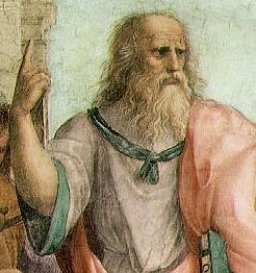 |
| The Greek philosopher, Plato |
Spiritual
awareness, however, is something which must be developed. It depends upon one’s
purity of thought and intention, and one’s detachment from the physical world.
As Plato argues in The Republic: “And the soul is like the eye: when
resting upon that on which truth and being shine, the soul perceives and
understands, and is radiant with intelligence; but when turned towards the
twilight of becoming and perishing, then she has opinion only, and goes
blinking about, and is first of one opinion and then of another, and seems to
have no intelligence?”[v]
So the soul, if it focuses on the perishable things of life, i.e. the material
world, will lack true awareness and comprehension (hence the dilemma of
materialists who deny that spiritual awareness even exists, because this
faculty is undeveloped within them). However, that soul which is focused on
higher reality will be able to develop spiritual awareness. Bahá’u’lláh gives the
following criteria for a true seeker after truth:
“But, O my
brother, when a true seeker determineth to take the step of search in the path
leading to the knowledge of the Ancient of Days, he must, before all else,
cleanse and purify his heart, which is the seat of the revelation of the inner
mysteries of God, from the obscuring dust of all acquired knowledge, and the
allusions of the embodiments of satanic fancy. He must purge his breast, which
is the sanctuary of the abiding love of the Beloved, of every defilement, and
sanctify his soul from all that pertaineth to water and clay, from all shadowy
and ephemeral attachments. He must so cleanse his heart that no remnant of
either love or hate may linger therein, lest that love blindly incline him to
error, or that hate repel him away from the truth… Only when the lamp of
search, of earnest striving, of longing desire, of passionate devotion, of
fervid love, of rapture, and ecstasy, is kindled within the seeker’s heart, and
the breeze of His loving-kindness is wafted upon his soul, will the darkness of
error be dispelled, the mists of doubts and misgivings be dissipated, and the
lights of knowledge and certitude envelop his being. At that hour will the
mystic Herald, bearing the joyful tidings of the Spirit, shine forth from the
City of God resplendent as the morn, and, through the trumpet-blast of
knowledge, will awaken the heart, the soul, and the spirit from the slumber of
negligence. Then will the manifold favours and outpouring grace of the holy and
everlasting Spirit confer such new life upon the seeker that he will find
himself endowed with a new eye, a new ear, a new heart, and a new mind. He will
contemplate the manifest signs of the universe, and will penetrate the hidden
mysteries of the soul. Gazing with the eye of God, he will perceive within
every atom a door that leadeth him to the stations of absolute certitude. He
will discover in all things the mysteries of divine Revelation and the
evidences of an everlasting manifestation.”[vi]
In short, my
response to Ricky Gervais’s statement that we are all agnostics is this: we can
know whether God exists if we develop the spiritual awareness to perceive God’s
existence. If we develop the attributes of a true seeker and develop the
spiritual susceptibilities of the soul, then we can reach a state of certitude,
i.e. knowledge that God exists and that Bahá’u’lláh is the Manifestation of God
for this day and age. This is not knowledge of the senses, which is limited.
Nor is it knowledge based on scientific experimentation, which is irrelevant to
the existence of God and higher spiritual reality. It is knowledge based on
both reason and spiritual awareness. We should understand that God exists with
our rational minds as well as with our inner perception. Someone who believes
in God sees evidences for His existence in every atom of the universe. He sees
the attributes of God mirrored in every element of creation, in every face and
every book. He sees God’s mystery and God’s manifold attributes infused into
the very warp and woof of the universe. Bahá’u’lláh writes: “From that which
hath been said it becometh evident that all things, in their inmost reality,
testify to the revelation of the names and attributes of God within them. Each
according to its capacity, indicateth, and is expressive of, the knowledge of
God. So potent and universal is this revelation, that it hath encompassed all
things visible and invisible.”[vii]
So, yes, it is possible to know that God exists, and it is possible, through
God’s Manifestations and His Revelation, to learn about God and His attributes.
A complete knowledge of God, or a direct knowledge of His Eternal Essence,
however, are impossible, since God is eternally transcendent.
 |
| St. Thomas Aquinas (Roman Catholic theologian) |
Next, Ricky
Gervais says: “So this is atheism in a nutshell. You say, ‘there’s a God’. I
say, ‘Can you prove that?’ You say, ‘No’. I say, ‘I don’t believe you then.’”
While there are some theists who would say they cannot prove the existence of
God, I would say that there is proof of the existence of God. If there already
are rational proofs of the existence of God, then there is no need for me to
independently come up with my own proofs and arguments. Though there are many such
proofs, I will mention only two here. ‘Abdu’l-Bahá explains,
in Some Answered Questions, in very simple terms, that the proof of
God is as follows: since there is imperfection, the concept of perfection must
exist. Since there is darkness, there must be light. Since there is contingent
being, there must be independent and absolute being. So there must be something
which is absolutely perfect, independent and absolutely good. This is an
argument which everyone can understand and which cannot be disproved. It is a
rational proof of the existence of God. Furthermore, since creation cannot come
into being on its own, there must be something which initiated it. The
existence of a painting implies the existence of a painter. Likewise, the
existence of a universe, which functions according to laws, requires the
existence of a Creator and Law-Giver. This argument is remarkable for its
simplicity, the fact that even a child can understand it, and the fact that it
cannot truly be disproved. ‘Abdu’l-Bahá, then, gives a solid and
completely-sound proof for the existence of God.

The next proof of
the existence of God, which I believe to be most remarkable, is the fact that
God interacts with humankind. We can open the pages of history and see, for a
fact, that there have been numerous interventions in human history. These
interventions take the form of Divine Revelations. God sends Perfect Mirrors of
himself, perfect and sinless human beings who act as conduits of the Divine.
These beings live on earth, living among us as we do, subject to pain and
pleasure, usually in the humblest of circumstances. Yet they possess direct
access to Divine knowledge, and every action which they perform is
divinely-guided. There are numerous examples of these special Beings throughout
history, including the Hindu Avatars of Rama and Krishna, the Biblical
Prophets, such as Noah, Abraham, Moses and Jesus Christ, and the Qur’ānic
Prophets Hūd, Sālih and Muhammad. To these we can also add Gautama Buddha, who
appeared in the Indian subcontinent after Krishna, and the Prophet Zoroaster,
who appeared in ancient Persia, Media or Bactria. In the modern age, we have
the Báb and Bahá’u’lláh, who both appeared in 19th century Persia
(now called Iran). To these may be added numerous others, whose names are lost
to history. However, evidence of their existence can be found in the
belief-systems of the Native Americans, Africans and other tribal peoples. Even
legends of Hercules, Woden and other ancient gods and heroes, point to the
existence of ancient Prophets or Teachers among the Europeans, Asians and other
peoples. Even many pagan gods, such as Jupiter, probably derive from an ancient
concept of the Creator-God, since Jupiter is etymologically connected with the
Sanskrit Dyauṣ Pitā, which means ‘Sky Father’. If that is not a description of
the same God as the God of the Bible, what is?

So, when Ricky
Gervais then says: “So, you believe in one God, I assume.. Okay, so you
believe. But there are about 3,000 to choose from, that have been, you know,
people have believed in, so. Okay, so. So basically, you believe in… you deny
one less god than I do. You don’t believe in 2,999 gods. And I don’t believe in
just one more.” I know that Ricky Gervais didn’t come up
with these arguments, but he has found something which can support his own
world-view of atheism, which is a belief-system, and is using these arguments
to defend that belief-system. I’m saying it’s a belief-system since he is
clearly expressing the tenets of that system. He’s not simply saying, I don’t
believe in God—he is rationalizing what that means and what he understands by the
concept of god. It is clear from this statement, for instance, that he believes
‘god’ to be anything labelled as ‘god’. Thus, if ancient Romans refer to the highest
god as Jupiter, then there must be a separate and distinct god called ‘Jupiter’.
Since the Hindus revere Dyauṣ Pitā, that must also be a god. Now we can count 2
gods. If we add Zeus, we have a 3rd god. Now, the Bible talks about
Elohim and YHWH, so that’s 2 gods there. Muslims revere Allāh. That makes 6.
Zoroastrians revere Ahura Mazda, so that makes 7. And so on. Eventually we
reach 3,000, at least according to whichever source Ricky Gervais gets his
beliefs from. It would be interesting to know which book gave him that idea.
Perhaps someone can provide a quote from that book in the comments to this
article, as I’d be interested to know the sources of Ricky Gervais’s theology.

What I believe is
this: Religions are all essentially one, and they come from the same source. I’m
not including made-up cults or sects here, but religion as it exists
historically, i.e. the major world religions, and the spiritual belief-systems
of many tribal peoples. The ancient Semites believed there was a Creator-God
called El. This later became Eloh or Elohim in the Torah. He was also referred
to as Yahweh. The ancient Europeans and Indo-Iranians believed in a ‘Sky Father’
who was the supreme God. The ancient Chinese believed in a higher power called
the Tao. They also believed in the Jade Emperor, which was an emanation of the
Tao, just as the Logos is the emanation of God in the New Testament. The Logos
brought creation into being. This Logos is also referred to as the Primal Will
or Primal Word of God. The Qur’ān describes Allāh and says that He has many
names. Indeed, there are traditionally 99 Names of God in Islam, and a 100th
or Greatest Name, that will only be revealed at the Day of Resurrection. Bahá’ís
believe the Greatest Name of God is Bahá’ and its derivatives, such as Abhá and
Bahí, etc. I do not count these as many gods, but simply different names for
the One God of creation. There is only one God and there is, in reality, only
one religion, which is progressively revealed to mankind. This is the Bahá’í
concept of ‘progressive revelation’. Since truth is one, there must only be one
religion and one God. In this day age, the latest stage of that religion is called
‘the Bahá’í Faith’. Christianity, Buddhism, etc. are just names for previous
stages in the development of this one religion. The laws and ordinances of
these previous religions are no longer applicable to the age in which we live,
but the essential teachings are the same and are eternally valid, e.g. the
divine virtues, moral principles, etc.

Ricky Gervais’s
last argument is this: “You see, if we take something like any fiction—any holy
book and any other fiction, and destroyed it, okay—in a 1000 years’ time, that
wouldn’t come back just as it was…” This argument is faulty for two reasons.
First of all, there is no reason why a Holy Book would reappear just as it was.
The Bible, for example, contains many divine teachings, but it is also a
human-made compilation. It is based on oral traditions that were passed down
over time. So, the teachings which it contains are valid and important, but the
exact form in which those teachings are preserved is not eternally valid. The
Bible is not some sort of divine Writ which was handed down from on high and
must be preserved as God revealed it, because all we have are oral records
preserved generations after the events which are described in the text. The
Teachings of Jesus Christ are preserved in the New Testament, but not
necessarily His exact words. So why would it need to appear in the same exact
form 1000 years from now? However, what would reappear, and has reappeared,
consistently over time, is the Divine Teachings. This negates Ricky’s whole
argument, since religion manifests itself and reappears with each new Messenger
of God, who brings the same essential teachings as all the previous. These
Messengers of God (also called Manifestations of God) appear roughly every
1,000 years, and the same divine religion reappears in a form which is suited
to that day and age, with the exact same core teachings. This attests to the
eternal validity of these teachings.
 |
| The Kitáb-i-Aqdas, a Holy Book revealed by Bahá'u'lláh in the 1870s |
The second reason this argument is invalid is that it presupposes that the form of religion should be the same from one millennium to the next. The core or essence of religion remains the same, but the laws and ordinances of religion change over time depending on human development. Furthermore, the terminology will change as it is revealed according to human capacity to understand it. So, a Prophet will not use terminology which we are incapable of understanding. Nor will a Prophet use languages which we cannot understand. Therefore, a Prophet who appears today will not reveal a book in Ancient Avestan or Sanskrit, since no one speaks these languages. That doesn’t mean Zoroaster and Krishna don’t come from the same God as Muhammad. What it means is that Muhammad revealed a text in Arabic so the Arabs could understand it, using terminology they could understand, and spiritual concepts they could grasp. But the Avesta of Zoroaster, the Bhagavad-Gita of Krishna, and the Qur’ān all come from the same Source. The problem is that Ricky Gervais is simply unaware of these concepts and is only regurgitating atheist arguments that he has read or heard somewhere, e.g. from Richard Dawkins, who also has a very basic and limited understanding of religion. He has no understanding of the nature of true religion or what the word ‘God’ really means. This concludes my argument.
For updates on
the latest blog posts, please follow me on
Twitter @Nicholas19. For more information the Bahá’í Faith, which I have
mentioned in this article, see bahai.org. For
more information on Bahá’u’lláh and His
life, see Bahaullah.org.
NJ Bridgewater
[i] Bahá’u’lláh, Asl-i-Kullu’l-Khayr
(Words of Wisdom), Tablets of Bahá’u’lláh Revealed After the Kitáb-i-Aqdas,
p. 156.
[ii] Bahá’u’lláh, Gleanings
from the Writings of Bahá’u’lláh, LXXXIII, pp. 164 – 165.
[iii] ‘Abdu’l-Bahá, Foundations
of World Unity, p. 51.
[iv] ‘Abdu’l-Bahá, The
Promulgation of Universal Peace, 24 July 1912, Talk to Theosophical
Society, Boston, Massachusetts, pp. 239 – 240.
[v] Plato (author), Benjamin
Jowett (translator), The Republic of Plato, Book VI.
[vi] Bahá’u’lláh, The
Kitáb-i- Íqán, v. 213, 216, pp. 192 - 196.