Tuesday, 28 August 2012

Msingi wa Tumaini


Msingi wa Tumaini

My wife and I have recently established a charity called Msingi wa Tumaini, which means "Foundation of Hope" in Swahili. It is a UK-based charity (currently a limited company but not yet registered with the Charities Commission). We were inspired to create the charity during our recent visit to Kenya, when we witnessed the deprivation and suffering of the hundreds of orphans who live in the village of Uyoma in Western Kenya, a village near Lake Victoria and the city of Kisumu. Many orphans and vulnerable children at the local Gagra Primary School suffer from hunger, HIV and a lack of proper clothes (including shoes) and educational materials (personal copies of school books, notebooks, pens, pencils, etc.). The local school lacks many basic facilities, including a library or computers. As many as three or four children share one old copy of a school book and have to memorise what they learn without reference to any notes as they cannot afford to buy paper or pencils. Many of the children also suffer from visible illnesses such as ringworm and jiggers in their feet which come from walking without shoes and sleeping on mud floors in the huts in which they live. The sheer number of orphans, many of whom are children of people who died from HIV, is overwhelming for any visitor. Many of them live with relatives, aunts, uncles or grandparents, many of whom have to support three or more orphans.

Children from Gagra Primary School wearing donated clothing
which was kindly given to us by Dragon School (Oxford)

With these thoughts stirring in our heads, we resolved upon the solution of creating a charity that focuses on the local school and the orphans and vulnerable children of the area. Msingi wa Tumaini aims to provide for the physical and educational needs of orphans, vulnerable children as well as young women and mothers, including child protection, basic literacy and numeracy, nutrition, hygiene, arts and crafts, agricultural skills, animal husbandry and other essential skills. We currently focus on Gagra Primary School in Uyoma, where there are a high number of orphans and vulnerable children. We also plan to establish a children’s and junior youth empowerment programme for children aged 7 to 14, which teaches moral values as well as literacy and numeracy skills.


Map of Kenya - Uyoma is located near Kisumu on Lake Victoria

Many women in Uyoma are also the sole providers for orphans who are usually nephews and nieces, grandsons and granddaughters or other relatives. We believe in the importance of women as agents of change in rural communities, so we aim to provide agricultural, literacy, numeracy, hygiene and child protection training that will empower them to become independent and assist them in passing on values and education to the next generation.

Feeding Programme

We aim to support the feeding programme, providing all the children at Gagra Primary School in Uyoma with a balanced school lunch, five days a week. The estimated cost for fully supporting the feeding programme is £4000 per term or £12000 per annum.

Children’s Centre

We aim to establish a children’s centre, which can serve as a place for the children’s and junior youth empowerment programme and will also include a play area, children’s library and venue for classes in arts and crafts and other vocational classes. The estimated cost for building the centre is £20,000.

Chicken Project

We aim to establish a chicken project to provide eggs for children’s lunches and eggs for sale to support the feeding programme. The initial cost for establishing the project will be £4000, but it is hoped that the project will become financially self-sustaining.

Dairy Project

We aim to establish a dairy project which will support the feeding programme, both by providing children with fresh milk as well as  financially through the sale of milk in the village. We will purchase ten dairy cows to start with. The estimated cost of establishing the project is £8000.

Water Project

Access to water is a basic human necessity. The village has no sources of clean, fresh water other than rain water, which most people are unable to collect and is unavailable in times of drought. The nearest source of open fresh water is Lake Victoria, which is several kilometres distant from the school. As such, we plan to sink a well to provide constant access to water for all the children at Gagra Primary School, as well as water for the dairy and chicken projects. This will cost roughly £15000.

Child Protection Training

Child abuse, in particular sexual abuse, is widely practised in Kenya. We plan to provide child protection training, providing a venue for professional volunteers from the United Kingdom to come to Kenya and educate teachers, parents and other stakeholders in the community.

Clothing and Toys

We collect used school uniforms in good condition as well as other children’s clothing, books and toys for orphans and vulnerable children at Gagra Primary School. When the Children’s Centre is constructed, we will also collect books and toys for the Children’s Centre. 


The following is a video of me teaching at the local primary school. You can see the size of the English class and the way the children share books. 


Please 'like' our Facebook page here and subscribe to our Twitter feed @mwtumaini. Our website is currently under construction but will be located at mwtumaini.org.

Please get in touch and I will give you the charity's bank details so you can set up a standing order. Even if you can only commit to £5 or £10 month, you will be helping to support orphans who desperately need help and will contribute to the development of hope, education and a brighter future for children and women in the village of Uyoma. For more details on how to pay, please contact me at nicholas.bridgewater AT mwtumaini.org

Nicholas J. Bridgewater
Director of Operations, 
Msingi wa Tumaini


Friday, 25 February 2011

Free Audiobook Version of A Year Amongst the Persians Now Available!

Edward Granville Browne (1862 - 1926) in Persian dress

A group recording of A year amongst the Persians; impressions as to the life, character, and thought of the people of Persia, received during twelve month's residence in that country in the years 1887-8 has now been completed! The whole length of the audiobook is 29 hours, 8 seconds and is divided into 46 sections. I was the Book Coordinator (BC) for this project. Leni was the Meta Coordinator (MC). The book was read by four readers: myself, antinomy, hefyd and Nasseem. The dedicated proof listener was mim@can. The book may be downloaded from this site:

http://librivox.org/a-year-amongst-the-persians-by-edward-granville-brown/

It can also be listened to directly at the Internet Archive page:

http://www.archive.org/details/year_amongst_persians_1102_librivox

Edward Granville Browne (1862 – 1926), born in Stouts Hill, Uley, Gloucestershire, England, was a British orientalist who published numerous articles and books of academic value, mainly in the areas of history and literature. His works are respected for their scholarship, uniqueness, and style. He published in areas which few other Western scholars had explored to any sufficient degree. He used a language and style that showed high respect for everybody, even toward those whom he personally did not view in positive light.

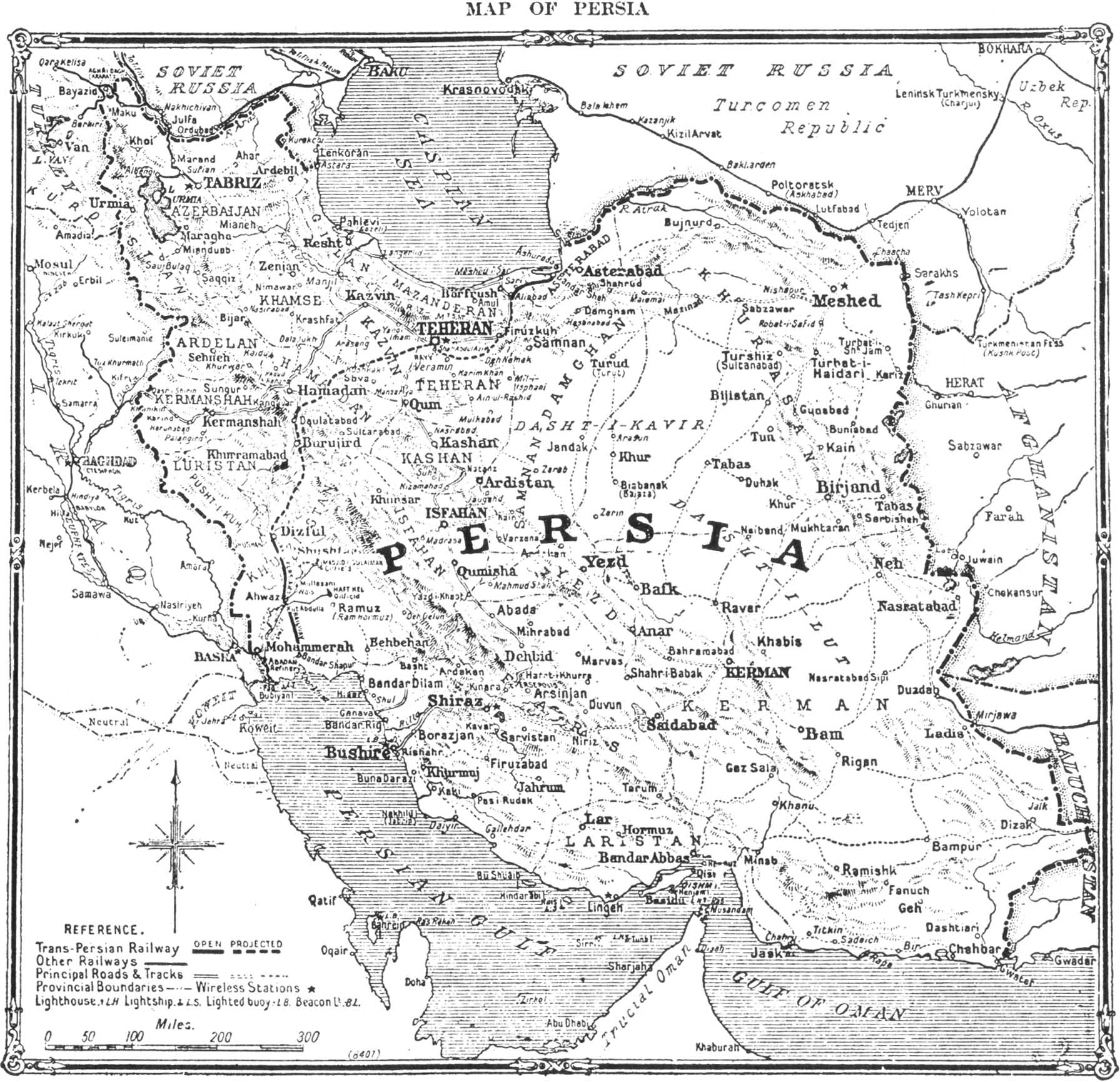
Map of Persia, from "the Dawn-Breakers" (originally published in 1932)

In A Year Amongst the Persians (1893) he wrote a sympathetic portrayal of a Persian society which few Westerners had ever seen, including a frank account of the effects of opium. It did not attract the attention it deserved at the time of its initial publication, but after his death in 1926 it was reprinted and became a classic in English travel literature. A Year Amongst the Persians includes moving accounts of the Bahá’í community in Iran. Concerning his meetings with the Bahá’ís of Iran, Browne writes: “The memory of those assemblies can never fade from my mind; the recollection of those faces and those tones no time can efface. I have gazed with awe on the workings of a mighty Spirit, and I marvel whereunto it tends”. The work contains many conversations between Browne and Bahá’ís, in which they demonstrate the proofs of their Faith through rational arguments. Browne didn't always agree with this arguments, but that may be because he didn't understand them fully.


Bahá’ís laying the foundation stone for the Bahá’í Temple in Ashkabad, Turkmenistan


The following is part of one of Browne's conversations with the Bahá’ís of Shiraz (pp. 336 - 340):

"I have already said that what is incumbent on every man is that he should believe in the 'manifestation' of his own age. It is not required of him that he should discuss and compare all previous 'manifestations.' You have been brought up a follower of Christ. We have believed in this 'manifestation' which has taken place in these days. Let us not waste time in disputing about intermediate 'manifestations.' We do not desire to make you believe in Muhammad but in Behá. If you should be convinced of the truth of Behá's teaching you have passed over the stage of Islám altogether. The last 'manifestation' includes and
sums up all preceding ones. You say that you could not accept Islám because its laws and ordinances are harsher, and, in your eyes, less perfect than those laid down by Christ. Very well, we do not ask you to accept Islám; we ask you to consider whether you should not accept Behá. To do so you need not go back from a gentle to a severe dispensation. Behá has come for the perfecting of the law of Christ, and his injunctions are in all respects similar; for instance, we are commanded to prefer rather that we should be killed than that we should kill. It is the same throughout, and, indeed, could not be otherwise, for Behá is Christ returned again, even as He promised, to perfect that which He had begun. Your own books tell you that Christ shall come 'like a thief in the night,' at a time when you are not expecting Him."


"True," I [Browne] replied, "but those same books tell us also that His coming shall be 'as the lightning, that lighteneth out of the one part under heaven and shineth unto the other part under heaven.'"


"There can be no contradiction between these two similes," answered the Bábí [Bahá’í]; "and since the phrase 'like a thief in the night' evidently signifies that when Christ returns it will be in a place where you do not expect Him, and at a time when you do not expect Him--that is, suddenly and secretly--it is clear that the comparison in the other passage which you quoted is to the suddenness and swiftness of the lightning, not to its universal vividness. If, as the Christians for the most-part expect, Christ should come riding upon the clouds surrounded by angels, how could He be said in any sense to come 'like a thief in the night'? Everyone would see him, and, seeing, would be compelled to believe. It has always been through such considerations as these that men have rejected the prophet whose advent they professed to be expecting, because He did not come in some unnatural and impossible manner which they had vainly imagined. Christ was indeed the promised Messiah, yet the Jews, who had waited, and prayed, and longed for the coming of the Messiah,rejected Him when He did come for just such reasons. Ask a Jew now why he does not believe in Christ, and he will tell you that the signs whereby the Messiah was to be known were not manifest at His coming. Yet, had he understood what was intended by those signs, instead of being led away by vain traditions, he would know that the promised Messiah had come and gone and come again. So with the Christians. On a mountain close by Acre [Mount Carmel] is a monastery peopled by Christian priests and monks, assembled there to await the arrival of Christ on that spot as foretold. And they continue to gaze upwards into heaven, whence they suppose that He will descend, while only a few miles off in Acre He has returned, and is dwelling amongst men as before.

Mount Carmel as it looked in 1894, before the establishment of the Bahá’í World Centre on the Mountain


"O be not blinded by those very misapprehensions which you condemn so strongly in the Jews! The Jews would not believe in Christ because He was not accompanied by a host of angels; you blame the Jews for their obstinacy and frowardness, and you do rightly. But beware lest you condemn yourselves by alleging the very same reason as an excuse for rejecting this 'manifestation.' Christ came to the Jews accompanied by angels--angels none the less because they were in the guise of fishermen. Christ returns to you as Behá with angels, with clouds, with the sound of trumpets. His angels are His messengers; the clouds are the doubts which prevent you from recognising Him; the sound of trumpets is the sound of the proclamation which you now hear, announcing that He has come once more from heaven, even as He came before, not as a human form descending visibly from the sky, but as the Spirit of God entering into a man, and abiding there."

"Well," I replied, "your arguments are strong, and certainly deserve consideration. But, even supposing that you are right in principle, it does not follow that they hold good in this particular case. If I grant that the return of Christ may be in such wise as you indicate, nevertheless mere assertion will notprove that Behá is Christ. Indeed, we are told by Christ Himself that many will arise in His name, saying, 'See here,' or 'See there,' and are warned not to follow them."

"Many have arisen falsely claiming to be Christ," he answered, "but the injunction laid on you to beware of these does not mean that you are to refuse to accept Christ when He does return. The very fact that there are pretenders is a proof that there is a reality. You demand proofs, and you are right to do so. What proofs would suffice for you?"

"The chief proofs which occur to me at this moment," I replied, "are as follows:--You admit, so far as I understand, that in each 'manifestation' a promise has been given of a succeeding 'manifestation,' and that certain signs have always been laid down whereby that 'manifestation' may be recognised. It is therefore incumbent on you to show that the signs foretold by Christ as heralding His return have been accomplished in the coming of Behá. Furthermore, since each 'manifestation' must be fuller, completer, and more perfect than the last, you must prove that the doctrines taught by Behá are superior to the teaching of Christ--a thing which I confess seems to me almost impossible, for I cannot imagine a doctrine purer or more elevated than that of Christ. Lastly, quite apart from miracles in the ordinary sense, there is one sign which we regard as the especial characteristic of a prophet, to wit, that he should have knowledge of events which have not yet come to pass. No sign can be more appropriate or more convincing than this. For a prophet claims to be inspired by God, and to speak of the mysteries of the Unseen. If he has knowledge of the Unseen he may well be expected to have knowledge of the Future. That we may know that what he tells us about other matters beyond our ken is true, we must be convinced that he has knowledge surpassing ours in some matter which we can verify. This is afforded most readily by the foretelling of events which have not yet happened, and which we cannot foresee. These three signs appear to me both sufficient and requisite to establish such a claim as that which you advance for Behá."

"As regards knowledge of the future," replied Haji Mirza Hasan, "I could tell you of many occasions on which Behá has given proof of such. Not only I myself, but almost all who have been at Acre, and stood in his presence, have received warnings of impending dangers, or information concerning forthcoming events. Some of these I will, if it please God, relate to you at some future time. As regards the superiority of Behá's doctrines to those of Christ, you can judge for yourself if you will read his words. As regards the news of this 'manifestation' given to you by Christ, is it not the case that He promised to return? Did He not declare that one should come to comfort His followers, and perfect what He had begun? Did He not signify that after the Son should come the Father?"

Such conversations were typical of Browne's encounters with Bahá’ís. All of Browne's objections have been answered and fully explained in numerous works of Bahá’í literature. The proofs that Browne seeks have been provided in many works, such as the numerous writings of 'Abdu'l-Bahá, the Báb's Seven Proofs, Bahá'u'lláh's Kitáb-i-Íqán and Gems of Divine Mysteries, The Brilliant Proof by Mírzá Abu’l-Fadl-i-Gulpáygání, Christ and Bahá'u'lláh by George Townsend, The Prophecies of Jesus by Michael W. Sours, Understanding Christian Beliefs by Michael W. Sours, Understanding Biblical Evidence by Michael W. Sours, Thief in the Night: The Case of the Missing Millennium by William Sears, The Proofs of Bahá'u'lláh's Mission, The Challenge of Bahá'u'lláh by Gary L. Matthews, He Cometh With Clouds by Gary L. Matthews, Preparing for Christ's New Name by Alex Gottdank, Promises Fulfilled: Christianity, Islam and the Baha'i Faith by Nabil I. Hanna, among many, many others in English, Arabic, Persian and other languages.

Edward G. Browne referred to Bahá’ís as Bábís, but this was a mistake on his part. Siyyid ‘Alí-Muhammad-i-Shírází (1819-1850), known as the “Báb”, which is Arabic for “Gate”, proclaimed that He was the Promised One of Islám. He declared His mission in 1844 and was executed by the Persian government in 1850. His followers were known as Bábís. The Báb also proclaimed that He was the Gate, Herald and Forerunner of an even greater Manifestation of God who would come after Him, the Promised One of all religions and Return of Christ in the Glory of the Father.

In 1863, Mírzá Husyan-‘Alí-yi-Núrí (1817-1892), known as Bahá’u’lláh (Arabic for “The Glory of God”), proclaimed that He was the Promised One foretold by the Báb. By the time Browne arrived in Iran, most Bábís had already accepted Bahá’u’lláh as the Promised One and were now known as Bahá’ís. A small group of Bábís, led by Mírzá Yahyá Núrí, known as Azal, who was Bahá’u’lláh’s younger half-brother, rejected these claims. Azal is notorious for poisoning his own Brother (i.e. Bahá’u’lláh) as well as trying to assassinate other enemies on numerous occasions. While the Báb had made Azal His nominal successor, this was only until the Promised One were to appear, upon which time Azal’s authority was supposed to cease. Most Bábís realised Azal’s depravity and turned to Bahá’u’lláh, whose character and spirituality were unsurpassed. Browne was sympathetic to Azal’s claims but was also impressed by the spirituality of the Bahá’í community. The followers of Azal (sometimes spelled Ezel) were known as Azalís.

In 1890, Browne journeyed to Cyprus (where he met Azal) and then onto 'Akká (Acre) in Palestine, where he met both 'Abdu'l-Bahá and Bahá'u'lláh. He later recorded this journey in the Introduction to A Traveller's Narrative. I have previously posted about the audio version of A Traveller's Narrative, which doesn't include the introduction. I have now recorded the introduction as part of the Short Nonfiction Collection Vol. 020. In the Introduction (p. xxxvi.), Browne described 'Abdu'l-Bahá as “a tall strongly-built man holding himself straight as an arrow, with white turban and raiment, long black locks reaching almost to the shoulder, broad powerful forehead indicating a strong intellect combined with an unswerving will, eyes keen as a hawk's, and strongly-marked but pleasing features… One more eloquent of speech, more ready of argument, more apt of illustration, more intimately acquainted with the sacred books of the Jews, the Christians, and the Muhammadans, could, I should think, scarcely be found even amongst the eloquent, ready, and subtle race to which he belongs”.

'Abdu'l-Bahá, "The Master"
 
He described his meeting with Bahá'u'lláh in the following words (pp. xxxix. - xli.):

"Of the culminating event of this my journey some few words at least must be said. During the morning of the day after my installation at Behjé one of Behá's younger sons entered the room where I was sitting and beckoned to me to follow him. I did so, and was conducted through passages and rooms at which I scarcely had time to glance to a spacious hall, paved, so far as I remember (for my mind was occupied with other thoughts) with a mosaic of marble. Before a curtain suspended from the wall of this great ante-chamber my conductor paused for a moment while I removed my shoes. Then, with a quick movement of the hand, he withdrew, and, as I passed, replaced the curtain; and I found myself in a large apartment, along the upper end of which ran a low divan, while on the side opposite to the door were placed two or three chairs. Though I dimly suspected whither I was going and whom I was to behold (for no distinct intimation had been given to me), a second or two lapsed ere, with a throb of wonder and awe, I became definitely conscious that the room was not untenanted. In the corner where the divan met the wall sat a wondrous and venerable figure, crowned with a felt head-dress of the kind called táj by dervishes (but of unusual height and make), round the base of which was wound a small white turban. The face of him on whom I gazed I can never forget, though I cannot describe it. Those piercing eyes seemed to read one's very soul; power and authority sat on that ample brow; while the deep lines on the forehead and face implied an age which the jet-black hair and beard flowing down in indistinguishable luxuriance almost to the waist seemed to belie. No need to ask in whose presence I stood, as I bowed myself before one who is the object of a devotion and love which kings might envy and emperors sigh for in vain!

The Room where E.G. Browne met Bahá'u'lláh


"A mild dignified voice bade me be seated, and then continued:- "Praise be to God that thou hast attained!... Thou hast come to see a prisoner and an exile.... We desire but the good of the world and the happiness of the nations; yet they deem us a stirrer up of strife and sedition worthy of bondage and banishment.... That all nations should become one in faith and all men as brothers; that the bonds of affection and unity between the sons of men should be strengthened; that diversity of religion should cease, and differences of race be annulled - what harm is there in this?... Yet so it shall be; these fruitless strifes, these ruinous wars shall pass away, and the 'Most Great Peace' shall come.... Do not you in Europe need this also? Is not this that which Christ foretold?... Yet do we see your kings and rulers lavishing their treasures more freely on means for the destruction of the human race than on that which would conduce to the happiness of mankind.... These strifes and this bloodshed and discord must cease, and all men be as one kindred and one family.... Let not a man glory in this, that he loves his country; let him rather glory in this, that he loves his kind...."

"Such, so far as I can recall them, were the words which, besides many others, I heard from Behá. Let those who read them consider well with themselves whether such doctrines merit death and bonds, and whether the world is more likely to gain or lose by their diffusion.

"My interview lasted altogether about twenty minutes, and during the latter part of it Behá read a portion of that epistle (lawh) whereof the translation occupies the last paragraph on p. 70 and the greater part of p. 71 of this book."

This pen-portrait is famous among Bahá’ís and remains one of his lasting legacies to the community which he studied for so long. While Browne’s sympathetic views on Azal were misguided, he made a great contribution to Bahá’í studies through his translations of historical works and his accounts of the Bahá’í community. Amongst Persians, at a time when nearly the whole nation was highly suspicious of foreigners, and in particular of any British or Russian person due to the political dynamics of that time, Edward Browne was well accepted by the people who knew him and his works. He is well remembered today, and a street named after him in Tehran, as well as his statue, remained even after the Iranian revolution in 1979.


LibriVox is a tremendous way of producing public domain, freely accessible Bahá'í literature. One needs only find a public domain Bahá'í text (and there are many at Internet Archive, Google Books, H-Net, etc.), create an account at the LibriVox forum, read the Newbie Guide to Recording, submit a 1-minute test  (to check one's settings are correct) and then one can begin to bring the world of Bahá'í literature to life in an audio format, so that the waiting masses of humanity can hear and appreciate the Word of God and the Divine Teachings. This is a great service to the Faith, that any Bahá'í can do.


If you like this recording, you will also like my recordings of:

Talks by Abdul-Baha Given in Paris by ‘Abdu’l-Bahá
A Traveller's Narrative Written to Illustrate the Episode of the Báb by ‘Abdu’l-Bahá
The Myserious Forces of Civilization by ‘Abdu’l-Bahá
Introduction to A Traveller's Narrative Written to Illustrate the Episode of the Báb by E. G. Browne (Sections 7 and 8 of the Short Nonfiction Collection Vol. 020)
The Bahai Revelation by Thornton Chase
In Galilee by Thornton Chase
The Universal Religion: Bahaism - Its Rise and Social Import by Hippolyte Dreyfus-Barney
The Brilliant Proof (Burhäne Lämé) in reply to an attack upon the Bahai Revelation by Peter Z. Easton by Mírzá Abu’l-Fadl-i-Gulpáygání
The Revelation of Baha-ullah in a Sequence of Four Lessons by Isabella D. Brittingham
Persian Self-Taught (in Roman Characters) with English Phonetic Pronunciation by Shaykh Hasan

For more Bahá'í recordings which I have completed, see: My Audiobooks

Friday, 28 January 2011

Free Audio Version of the Brilliant Proof Now Available


My recording of The Brilliant Proof (Burhäne Lämé) in reply to an attack upon the Bahai Revelation by Peter Z. Easton by Mírzá Abu’l-Fadl Gulpáygání has recently been completed and catalogued at LibriVox.org! It has already been downloaded 68 times since it was catalogued on the 24th of January (only 4 days ago)!

“In these days,” writes the renowned Bahá’í scholar, Mírzá Abu’l-Fadl, “which are the latter days of 1911, A. D. and the early days of 1330 A. H., I have seen a curious article which astonished me. What did I see? I find that one of the missionaries of the Protestant sect, who accounts himself among the learned men of the twentieth century, a helper of the pure religion of Christ and one of the civilized and cultured occidentals, by name, Peter Z. Easton, has been so provoked by jealousy at the universal spread of the heavenly word of His Holiness Abdul-Baha throughout vast expanses of Europe that he has trespassed the limit of courtesy and humanity and published an article replete with execration and calumny in the magazine “Evangelical Christendom.” …Briefly, as this servant [Mírzá Abu’l-Fadl] carefully perused and weighed the above mentioned article, it was found that Peter Z. Easton, in his own supposition, has clung to “four proofs” in opposing the great Bahai Cause. We will therefore mention these four points and show the falsity of his fanciful ideas in each instance.”


Mírzá Abu’l-Fadl

A number of works were written in the 19th century to defend the Bábí and Bahá’í Faiths from attacks made by Muslim scholars and to demonstrate the spiritual proofs and evidences of the Revelations of the Báb and Bahá’u’lláh (notably the “Seven Proofs” of the Báb and the “Book of Certitude” of Bahá’u’lláh) . As the Bahá’í Faith spread to Europe and America in the late 19th and early 20th centuries, it began to attract the attention of Christian missionaries and preachers. While many Christian clergymen were positive towards the Faith and its universal message, there were also attacks against the Faith by ministers who saw it as a threat. Peter Z. Easton was one of these. Mírzá Abu’l-Fadl, who was given the posthumous title of “Apostle of Bahá’u’lláh”, took on Easton’s challenge and thoroughly refuted his arguments in “The Brilliant Proof”. ‘Abdu’l-Bahá was so impressed by this work that He wrote: "His Honour Mírzá Abu'l-Fadl has written a treatise answering the criticisms of a London preacher. Each one of you should have a copy. Read, memorize and reflect upon it. Then, when accusations and criticisms are advanced by those unfavourable to the Cause, you will be well armed."

LibriVox is a tremendous way of producing public domain, freely accessible Bahá'í literature. One needs only find a public domain Bahá'í text (and there are many at Internet Archive, Google Books, H-Net, etc.), create an account at the LibriVox forum, read the Newbie Guide to Recording, submit a 1-minute test  (to check one's settings are correct) and then one can begin to bring the world of Bahá'í literature to life in an audio format, so that the waiting masses of humanity can hear and appreciate the Word of God and the Divine Teachings. This is a great service to the Faith, that any Bahá'í can do.

If you like this recording, you will also like my recordings of:

Talks by Abdul-Baha Given in Paris by ‘Abdu’l-Bahá
A Traveller's Narrative Written to Illustrate the Episode of the Báb by ‘Abdu’l-Bahá
The Myserious Forces of Civilization by ‘Abdu’l-Bahá
The Bahai Revelation by Thornton Chase
In Galilee by Thornton Chase
The Universal Religion: Bahaism - Its Rise and Social Import by Hippolyte Dreyfus-Barney
The Revelation of Baha-ullah in a Sequence of Four Lessons by Isabella D. Brittingham

For more Bahá'í recordings which I have completed, see: My Audiobooks

Saturday, 4 December 2010

Free Audio Version of A Traveller's Narrative by ‘Abdu’l-Bahá

‘Abdu’l-Bahá
 
My recording of A Traveller's Narrative has just been catalogued and released at LibriVox.org! A Traveller's Narrative Written to Illustrate the Episode of the Báb is a work by ‘Abdu’l-Bahá (1844-1921), the Centre of the Covenant and appointed successor of Bahá'u'lláh, the Founder of the Bahá'í Faith. It was originally published anonymously but the Author is none other than ‘Abdu’l-Bahá Himself. It was written in 1886 and first published in the original Persian in Bombay in 1890. Edward G. Browne obtained a copy of the book while travelling throughout Iran and published an English translation in 1891 (Cambridge University Press). My recording is based on Browne's translation.

Edward G. Browne


“This book is the history of a proscribed and persecuted sect written by one of themselves,” writes Professor Edward Granville Browne. “After suffering in silence for nigh upon half a century, they at length find voice to tell their tale and offer their apology. Of this voice I am the interpreter.”

This work is the story of the life of the Siyyid ‘Alí-Muhammad-i-Shírází (1819-1850), known as the “Báb”, which is Arabic for “Gate”. He claimed to be none other than the Promised One of Islám and a new Manifestation of God. He also proclaimed that He was the Gate, Herald and Forerunner of an even greater Manifestation of God who would come soon after Him, the Promised One of all religions and Return of Christ in the Glory of the Father, Mírzá Husayn-‘Alí-yi-Núrí (1817-1892), known as Bahá’u’lláh (Arabic for “The Glory of God”). The followers of the Báb were known as Bábís. When Bahá’u’lláh declared His mission in 1863, most Bábís accepted Him as the Manifestation foretold by the Báb. Bahá’u’lláh’s followers then became known as Bahá’ís. This book also describes Bahá’u’lláh’s exile and His teachings. Edward G. Browne continued to refer to Bahá’ís as Bábís, but this isn’t quite correct, as the Bahá’í Faith represents a new religious dispensation and is now recognised as the second most widespread religion on the planet and most recent of the great world religions.

‘Abbás Effendí, also known by the title of ‘Abdu’l-Bahá (Arabic for “Servant of the Glory”), was the eldest son of Bahá’u’lláh and leader of the Bahá’í Faith after Bahá’u’lláh’s passing. Browne, who met the Author in Palestine, writes (p. xxxvi.) that ‘Abdu’l-Bahá was “a tall strongly-built man holding himself straight as an arrow, with white turban and raiment, long black locks reaching almost to the shoulder, broad powerful forehead indicating a strong intellect combined with an unswerving will, eyes keen as a hawk's, and strongly-marked but pleasing features… One more eloquent of speech, more ready of argument, more apt of illustration, more intimately acquainted with the sacred books of the Jews, the Christians, and the Muhammadans, could, I should think, scarcely be found even amongst the eloquent, ready, and subtle race to which he belongs”.

I decided not to read the whole introduction by E.G. Browne. Instead, I have recorded just the first three pages thereof (pp. vii. – ix.), which give a brief explanation of the work. While the introduction is very interesting, it is also very long, constituting a narrative in itself, and may distract the reader from ‘Abdu’l-Bahá’s story. The remainder of the introduction contains a lot of useful information, including Browne’s account of how he became interested in the Bábí and Bahá’í Faiths (pp. ix. – xx.) and his famous verbal portrait of Bahá’u’lláh (pp. xxxix. – xl.). The entire introduction would best be read as part of a short works collection. I have also omitted E.G. Browne’s footnotes, which often contain long quotations in Arabic or Persian or otherwise distract the reader from the narrative. Likewise, the long notes at the end of the book have been omitted.


LibriVox is a tremendous way of producing public domain, freely accessible Bahá'í literature. One needs only find a public domain Bahá'í text (and there are many at Internet Archive, Google Books, H-Net, etc.), create an account at the LibriVox forum, read the Newbie Guide to Recording, submit a 1-minute test  (to check one's settings are correct) and then one can begin to bring the world of Bahá'í literature to life in an audio format, so that the waiting masses of humanity can hear and appreciate the Word of God and the Divine Teachings. This is a great service to the Faith, that any Bahá'í can do.

If you like this recording, you will also like my recordings of:


Talks by Abdul-Baha Given in Paris by ‘Abdu’l-Bahá
The Myserious Forces of Civilization by ‘Abdu’l-Bahá
The Bahai Revelation by Thornton Chase
In Galilee by Thornton Chase
The Universal Religion: Bahaism - Its Rise and Social Import by Hippolyte Dreyfus-Barney
The Revelation of Baha-ullah in a Sequence of Four Lessons by Isabella D. Brittingham

For more Bahá'í recordings which I have completed, see: My Audiobooks

Friday, 5 November 2010

Free Audio Version of The Universal Religion by Hippolyte Dreyfus-Barney

Hippolyte Dreyfus-Barney (1873-1928)

I've recently completed an audiobook recording of The Universal Religion: Bahaism - Its Rise and Social Import by Hippolyte Dreyfus-Barney. This audiobook, as with all LibriVox audiobooks, is in the public domain and freely downloadable. One can find a pdf version of the text of this book here.

The book is over 100 years old but it still speaks to the modern mind. Hippolyte presents the Bahá’í Faith as he understood it, giving a brief outline of its history and explaining its import for society and the future. Although a turn-of-the-century man, Hippolyte had a vision that was futuristic, for the message he presents is not a human, transitory one, but the message of Bahá'u'lláh, the Manifestation of God for this day and age. The message of Bahá'u'lláh cannot be said to be dated. It is a message for this age and outlines the pattern of the future society. Bahá'u'lláh's teachings and writings were not wholly available in the West and had yet to be more fully explained and elaborated by 'Abdu'l-Bahá and Shoghi Effendi. Nevertheless, the central message was understood and the principal goal of the Faith known to every believing Bahá’í—the unification of mankind in "one universal Cause, one common Faith" (Gleanings, CXX., pp. 254-255).

“Bahaism is not a new religion,” writes Hippolyte Dreyfus-Barney, “It is religion renewed… it does not pretend to represent the whole Truth; on the contrary, it recognises Truth in fundamental principles which are the basis of all former dispensations, and which for that very reason form the standpoint of concord too long lost sight of. And it requires people to renounce ancient superstitions, to abandon the dead letter in order to be penetrated by the living and vivifying spirit, then by that very means it confirms the original purity of their religion, whilst helping them to know and love everything profoundly beautiful in the others… it will suffice for me to indicate that the Bahais believe that from all eternity God has raised up among human creatures higher beings who have inculcated mankind with the great moral principles on which societies are founded, and have thus been the supreme guides of its evolution.”

Hippolyte Dreyfus earned his doctorate in law in February 1898 and became the first French Bahá’í in 1901. In 1903 he gave up his legal career to devote himself to oriental studies. He enrolled at the École pratique des hautes études university in Paris, where he studied Arabic and Persian to be able to translate the Bahá’í writings into French. He was one of the only Western Bahá’ís of his generation to received such formal training. He was the author of numerous books, articles and translations of the Bahá’í faith. Dreyfus-Barney attained in September 1902 with an American Bahá’í, Lua Getsinger, an audience with Muzaffaru’d-Din Shah in Paris.

Muzaffaru'd-Dín Sháh Qájár (1853 - 1907)

During this meeting the Shah was personally handed a petition to protect their co-religionists in Iran. After his marriage (1911) with the American Bahá’í Laura Clifford Barney, he adopted the name Dreyfus-Barney. He also traveled to numerous countries and represented the Bahá’ís in legal disputes. He died on 20 December 1928 and was buried in the Montmartre Cemetery in Paris. He was posthumously appointed by Shoghi Effendi as one of the 19 Disciples of ‘Abdu’l-Bahá.

NOTE: Please note that the term Bahaism is no longer used by Bahá’ís. The appropriate term is the Bahá’í Faith.

Monday, 11 October 2010

Free Audio Version of the Mysterious Forces of Civilization


I've recently completed an audiobook recording of the Mysterious Forces of Civilization by 'Abdu'l-Bahá. The Mysterious Forces of Civilization (Persian: Risálih-i-Madaníyyih) is a work written before 1875 by ‘Abbás Effendí, known as ‘Abdu’l-Bahá (the Servant of Bahá) (1844-1921). The Persian text was first lithographed in Bombay in 1882 and printed in Cairo in 1911. ‘Abdu’l-Bahá was the eldest son and appointed successor of Bahá’u’lláh, the Founder of the Bahá’í Faith. The original text of this work was written and published anonymously, and the first English translation (by Johanna Dawud) was published in London in 1910 and Chicago in 1918, under the title ‘Mysterious Forces of Civilization’ written by "an Eminent Bahai Philosopher." This audiobook is based on the 1918 edition. Another translation was completed by Marzieh Gail and published in 1957, with an introduction by Horace Holley. The title was re-translated as “The Secret of Divine Civilization”.

The book was widely known in its time as an attempt to improve the degraded condition of Persia (Iran). The author frequently references current issues that were being debated, such as whether to modernize and accept Western technology, or to reject Western culture and rely on technology developed in Persia and the Islamic world.

There are many public domain Bahá’í texts available online (including scanned pdfs at Internet Archive). Others can be found at Bahá’í Library Online and H-Net Baha'i (both in English/French and Arabic/Persian). In general, works are in the public domain (in the US) if they were published before 1923. Only works which are public domain in the United States can be recorded for LibriVox, because files are stored in the Internet Archive, which is based in the US. More books (published after 1923) will apparently enter the public domain in the Holy Year 2019, thus increasing the number of potential Bahá’í audiobooks that could be recorded for LibriVox.

Nevertheless, many great Bahá’í books were published before 1923 and I look forward to seeing many more of them available as public domain audiobooks. It would be great to see more Bahá’ís involved in LibriVox and other projects to make free public domain Bahá’í audiobooks, so that the teachings may become more widely available in an audio format, for the benefit of all the waiting masses that shall enter into the Faith "by troops" (Baha'u'llah, The Summons of the Lord of Hosts, v. 270, p. 135).

Monday, 4 October 2010

Free Audio Version of Paris Talks by 'Abdu'l-Bahá


I've recently completed my recording of Paris Talks (a.k.a. Talks by Abdul Baha Given in Paris) from an old, public domain edition available on Internet Archive (see here). Before recording, I divided it into 39 short sections, worked out the word counts, etc. and set it up as a solo project on the LibriVox forums. LibriVox is a volunteer initiative to record every book available in the public domain. As one can imagine, there are millions of books in the world (I'm not sure how many in the public domain), so LibriVox has a huge goal. Nevertheless, over 3,000 audiobooks have been produced so far, and each of these is free to download and listen to legally. In fact, since they're public domain, one could even sell the recordings on ebay (which actually does happen). A few of my audiobooks, including The Bahai Revelation and In Galilee by Thornton Chase, The Revelation of Baha-ullah in a Sequence of Four Lessons by Isabella D. Brittingham, Persian Self-Taught, Esperanto Self-Taught and others are currently being sold by ebay sellers not associated with me in any way. In a sense, though, that's the beauty of the public domain. It is free and universally available to all. If one wants to make a cd of a public domain book and sell it, one is free to do so. Knowledge must be universally accessible, and LibriVox is a part of the initiative to make it so.

Shoghi Effendi envisioned the internet age in the 1930's ("A mechanism of world inter-communication will be devised, embracing the whole planet, freed from national hindrances and restrictions, and functioning with marvellous swiftness and perfect regularity",  The World Order of Baha'u'llah, p. 203) and the Universal House of Justice envisions a convergence of information technologies (telephone, computer, etc.) into one universally accessible means of communication and distribution of knowledge ("It is apparent that the decades immediately ahead will see the integration of telephone, television, and computer technologies into a single, unified system of communication and information, whose inexpensive appliances will be available on a mass scale", 1999 Feb, Who is Writing the Future).
Bahá'u'lláh teaches that we must seek the truth. Indeed, the greatest oppression is to seek the truth and not know where to find it (""What "oppression" is more grievous than that a soul seeking the truth, and wishing to attain unto the knowledge of God, should know not where to go for it and from whom to seek it?" The Kitab-i-Iqan, p. 30). The internet is helping us to overcome this oppression. Wikipedia, Internet Archive, Project Gutenberg and LibriVox are among the many projects, movements and initiatives led by volunteers to open up the entire realm of human knowledge and make it accessible to all and downloadable by all. With such tools, if one searches the world religions and their teachings, one cannot fail to find the Bahá'í Faith. If one has an open mind, frees oneself from prejudice and past superstitions and purifies oneself (as described in The Kitab-i-Iqan Book of Certitude), one cannot fail to recognise its truth. The internet is thus one of the great means for conducting a search after truth and true salvation.

LibriVox is a tremendous way of producing public domain, freely accessible Bahá'í literature. One needs only find a public domain Bahá'í text (and there are many at Internet Archive, Google Books, H-Net, etc.), create an account at the LibriVox forum, read the Newbie Guide to Recording, submit a 1-minute test  (to check one's settings are correct) and then one can begin to bring the world of Bahá'í literature to life in an audio format, so that the waiting masses of humanity can hear and appreciate the Word of God and the Divine Teachings. This is a great service to the Faith, that any Bahá'í can do. It's easy, it's fun, it's worthwhile and everyone can do it. You don't need to have the vocal chords of Patrick Stewart. Anyone can be a great audiobook reader. And the Bahá'í presence at LibriVox needs to increase many-fold.

In addition to public domain English texts, there is a  huge possibility to record original works of the Báb, Bahá'u'lláh and 'Abdu'l-Bahá, the original Persian and Arabic texts of which would now be public domain. Indeed, this is a great service which Arabic and Persian speaking Bahá'ís could do, by producing easily accessible, free versions of the Bahá'í writings in their original languages through LibriVox! :)

My recording of Talks by Abdul Baha Given in Paris is 6 hours, 26 minutes, 34 seconds in length and can be downloaded either from the LibriVox catalogue page or from the Internet Archive page. Internet Archive hosts all of LibriVox's finished recordings. It was catalogued on the 28th of September 2010 and, as of the 4th of October 2010, it has already been downloaded 120 times. I hope you enjoy it. If you like this recording, you will also like my recordings of:


The Bahai Revelation by Thornton Chase (already download 1,715 times)
In Galilee by Thornton Chase (already downloaded 395 times)
The Revelation of Baha-ullah in a Sequence of Four Lessons by Isabella D. Brittingham (already downloaded 2,311 times)

For more Bahá'í recordings which I have completed, see: My Audiobooks